
“When the Colosseum falls, Rome will fall; when Rome falls, the entire world will fall”
Venerable Veda
WAS THE COLOSSEUM THE FIRST AMPHITHEATER IN ROME?

Absolutely not.
With increasing importance and prestige, the gladiator games deserved a better location than the simple city squares, set up for the occasion with temporary stands. In 52 BC Curione, on the occasion of the munus in honor of his father, wanted to amaze the people or, better said, his potential electors, by having two theaters built against each other, which could rotate by means of pins, to form a construction the only hemicycle able to host the shows.
🔹The shape was considered functional to gladiator games and the Romans thus realized that they had invented a new architectural form: the amphitheater. The first was built by Statilius Taurus in 29 BC, did not last very long and was destroyed by the terrible fire of 64 AD.
After the devastating fire of August 64 AD that probably started from wooden structures at the Circus Maximus, which destroyed much of the center of Rome, the Emperor Nero began the construction of a new residence, which for its splendor and grandeur went down in history with the name of Domus Aurea (golden house).
Designed by the architects Severus and Celer and decorated by the painter Fabullus, the palace consisted of a series of buildings separated by gardens, woods, vineyards and an artificial lake, located in the valley where the Colosseum stands today, for which an aqueduct branch had been designed.
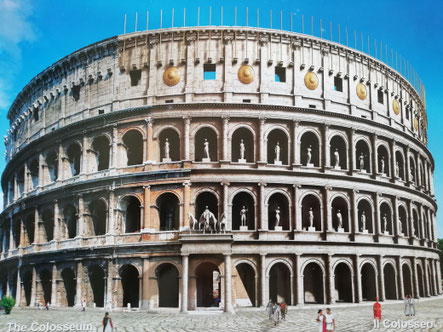
Colosseum is a medieval name never used by ancient Romans that derives from the Colossus of Nero that stood 30 mts high nearby. Its official name was Flavian Amphitheater (literally double theater), built by the Flavian imperial dynasty (Vespasian and his two sons Titus and Domitian) who dismantelled most of the Domus Aurea, giving this public area back to the population after it had been confiscated.
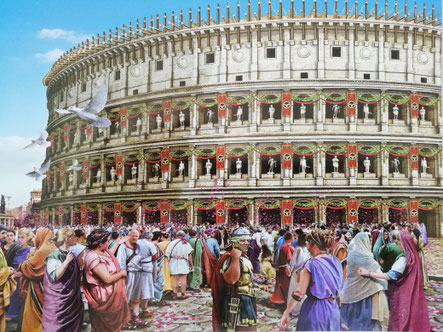
The Colosseum was not the oldest Roman amphitheater ever built but the largest with approximately 80.000 spectators ( 50.000 seated) who could use the 80 numbered lower arches to access and reach their place according to their gender and social status. The plebe and slaves required a free invitation, distributed days before when the event was announced to the city by the heralds. Important personalities reached their seat directly on the lower level, separated from the other social classes. The plebe sat in the middle level whereas slaves and women stood on the top level, divided in diferrent sections: this system kept a social stratification and avoided promiscuity.
Lenght: 187 mts – Width: 156 mts – Height: 48 mts
Bakeries and entertainment buildings such as the Colosseum and Circus Maximus were efficiently run by the State to provide free bread and fun (panem et circenses) to the Roman citizens to keep the social stability and prevent riots.
Its building started by Vespasian in 70 AD, financed by the siege of Jerusalem by general Titus, his first son, who completed the top floor and inaugurated it in 80 AD offering 100 consecutive days of games and over 5000 animals to be killed.
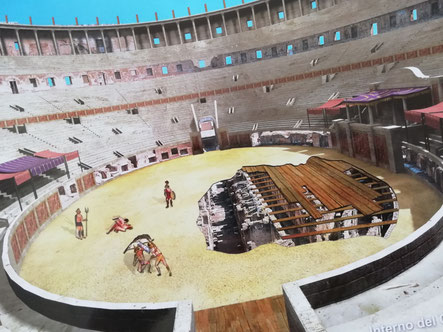
Completed by Domitian in 82 AD with the underground rooms and corridors where animals and criminals were kept before being lifted up.
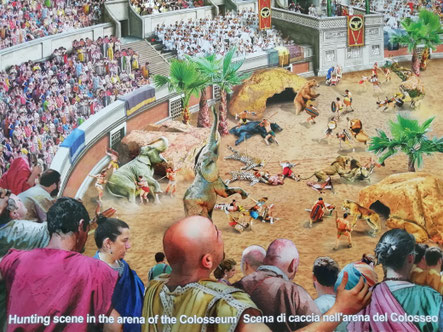
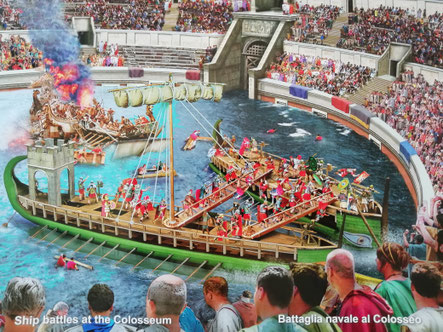
The wooden arena was covered with sand (arena in Latin) to absorbe the blood and facilitate the cleaning. There were 28 trapdoors and central winches to lift materials, animals and sceneries. Spectators were protected by a metal net, elephant tusks and archers. Sailors outside could open the velarium, a retractable ceiling in hemp to protect the crowd from sun and rain. In case of emergency, the building could be evacuated in 15 minutes using the fast inclination of the vomitoria stairs all around.
Public latrines located at the lower level completed the organization as a modern stadium.
Gladiator is a general word deriving from gladio, the short sword used by the legioneers but more technical names were assigned according to their fighting equipment (Trax, Secutor, Retiarius, etc). They were mostly war prisoners trained to become professional fighters obliged to win to survive and save money to buy their freedom (a wooden word called rudus).
Their diet was mostly vegetarian: proteins from beans and carbs from barley.
A day at the Colosseum is long and well organized: animal hunts and shows in the morning, capital executions at 12 (roman citizens were killed fast, non-romans were killed spectacularly even reenacting episodes of Greek-Roman Mythology such as Orpheus playing music to the animals), gladiator combats in the afternoon organized in sophisticated way to entertain the crowd.
Q1: Did gladiators die all the time?
A1: absolutely not. He or She (yes there could be women) could be spared if they had shown their courage and skills. A gladiator’s training required time and money, represented an investment by the lanista (owner of the gladiator’s school) which had to be refunded in case of death.
Q2: Were cristians killed here?
A2: no literary nor historical evidence has been found to state it but the catholic church believes it and still celebrates here the stations of the cross on Easter. I believe that some Christians could be executed in this building since they were for long considered enemies of the state and criminals against the emperial authority and the social stability.
Q3: Did they bet money?
A3: Archeologists have recently found coins and dices in the sewer system which is the evidence that betting was widespread even between the games and shows
Gladiator combats were abolished in 437 AD but huntings went on until 523. During its 443 years of activity, it is estimated that 2 5 million animals were killed around the roman empire.
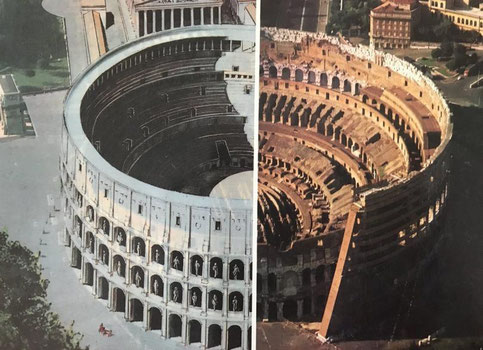
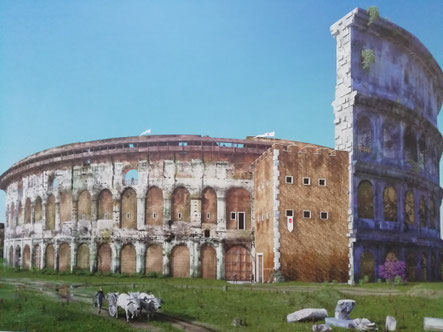
During the Middle Age it was used as a quarry where to take metals, marbles and rubble to be recycled for churches and aristocratic houses; filled with workshops in the outer arches and a private fortress built by the Frangipane family in the 12th century. Some Popes had projects to turn it into a wool factory and a church but could not live enough to realize it.

Heavily damaged by several earthquakes (extremely strong the one in 1349), it was abandoned until the first restorations in the mid 1700s.
The Passion of Jesus lives again in the Colosseum starting from the 18th century. In the Holy Year of 1750, announced by Pope Benedict XIV, 14 shrines (1 still visible) and a large cross were erected in this place. By the will of the Pope himself, on 19 September 1756 the monumental amphitheater was consecrated to the memory of the Passion of Christ and the Martyrs.
The brick corner spears were built to reinforce it in the 1800s by Raffaele Stern and Giuseppe Valadier (same restorers of the Arch of Titus).
UNESCO site since 1980 and recently voted as one of the new 7 wonders of the world since 2007, nowadays the Colosseum is a national monument visited by 35,000 people everyday.
Do not miss to visit the Roman Forum (former market) & the Palatine Hill with its Imperial Palace and several fountains (Fontana delle pelte).
Want a guided tour of the Colosseum?

 Maurizio Rome Guide