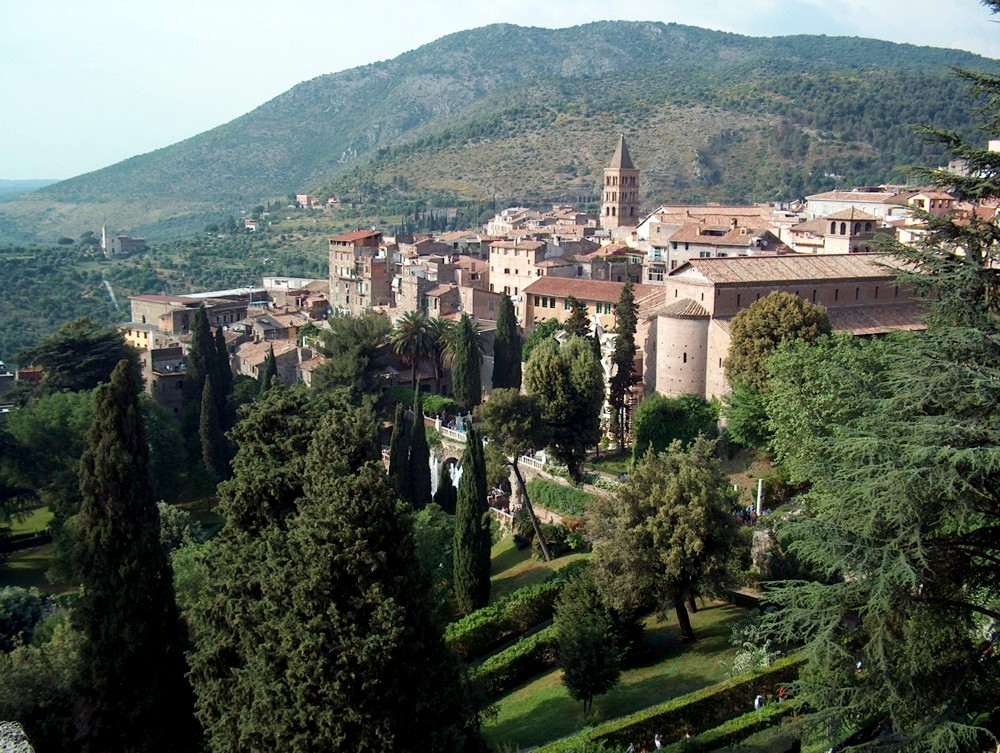
Tivoli is a very old settlement and, from its 235 meters above sea level, looks towards its historically rival city of Rome. The modern town has 60,000 inhabitants, is located 33 kms east of Rome and has the imperial eagle on his flag permitted by Frederick Redbeard in the XII century. Its citizens are proud to live in a city even older than the capital: ancient Tiburn was founded by the Greek Tibur (son of Catillo, to whom the mountain above the city is dedicated) on April 5th 1215 BC in the same years when they believed the Greeks were sieging the city of Troy.
It was later conquered by the Roman general Furio Camillo in 338 BC and connected to Rome by the Tiburtina road (Roman roads were named after their destination or by the politician who built it): it was in a very happy position, in the middle of important commercial routes.
According to the myth, this territory had been taken by some of the Argonauts and were involved in the battle against the trojan Aeneas who had arrived on the coast of Latium and married Lavinia, daughter of Latino. The strong rivality against the Romans continued for centuries and Tivoli always tried to keep a certain independence: a proud city aware of its excellent position in a fertile and rich land, close to a the river Aniene, a tributary of the Tiber.
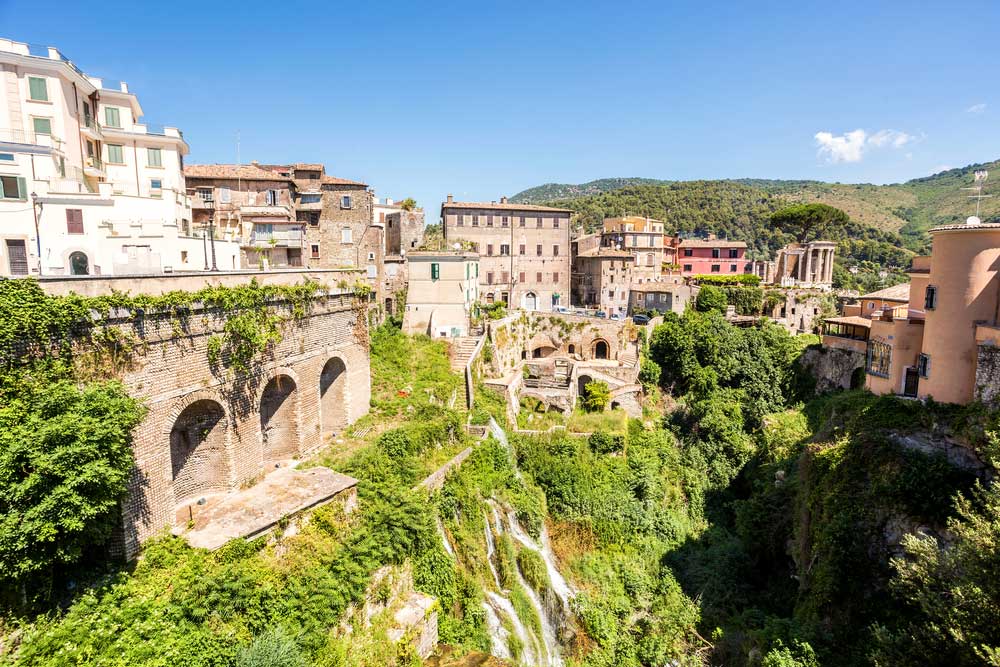
The so called Temple of Vesta and Temple of the Sybil probably were dedicated to Hercules and Tiburn (II cent BC) and stand nowadays next to the Gregorian Villa, on top of the ancient acropolis and by the waterfall created in 1835 after excating the mountain and changing the river bed to prevent natural disasters. Nearby are the Gregorian Bridge built in 1834 by Pope Gregory XVI (bombed by Nazis and reconstructed) and the charming Gregorian Villa which blends ancient roman villas and natural settings. An interesting structure looking like a mini Pantheon and known as the Tempio della Tosse (corruption of the Tuscia family who probably financed it) has not been interpreted but could be likely used also as an astronomical watch. All above-mentioned temples were turned into churches in the Middle Age. The monumental Sanctuary of Winning Hercules stands next to old foundries and factories showing the industry of the town.

The Rocca Pia is a castle built by Pope Pius II to protect the land when the city had to give up his aspiration of independence and became a ‘comune’. It hosted several important personalities and here is where Pope Paul III met and authorized St Ignatius to form the Gesuit order in 1539. In the 1900s it was used as a jail and now it is a free museum open on weekends.

Approaching the city, it is still possible to see the ancient bridge and the Mausoleum of the Plautii, the most considerable local family that reached the consolate in Rome during Augustus’ times. A few kilometers before, along the Via Tiburtina, are the quarries of travertine which is the most common stone used for the Roman monuments, including the Colosseum, the basilica of St Peter and the fountain of the four rivers.
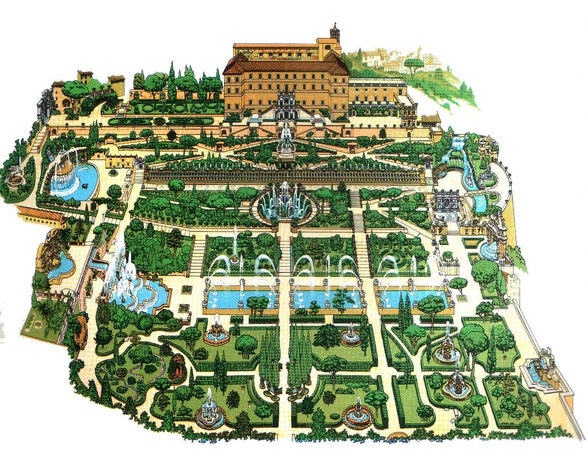
Also known as Tivoli Gardens, Villa d’Este was imitated all over the world for its elegnace, sense of beauty created by the harmony between nature and architecture. Five hundred fountains supplied by the water of Aniene [ani’n] river, a tributary of the Tiber, digging a tunnel of 280 meters under the city.
It was commissioned in 1550 by Cardinal Ippolito d’Este, a member of the wealthy ferrarese family of Este and son of Lucrezia Borgia, after being appointed Governor of the town by Pope Julius III Del Monte. An old benedictine monastery was turned into a magnificent villa, inspired by the splendor of imperial residences with specific reference to the nearby Hadrian’s villa.
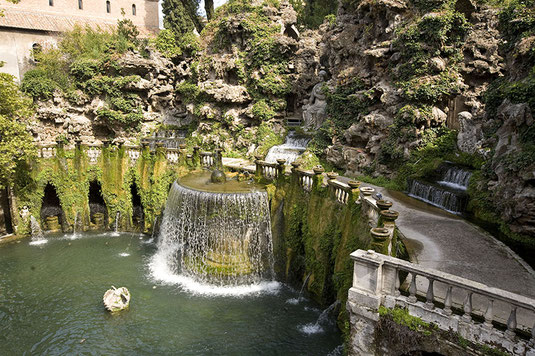
Magnificent renaissance suburban villa where to invite important guests and spend pleasant hours surrounded by nature and the sound of water coming from its spectacular fountains. An oasis of refreshment during the hot and humid summer months.
An Italian Garden with its geometrical and linear planning as opposed to the English Garden with its romantic ideal adapting to the natural forms of the location.
Designed by the genius of Pirro Ligorio with works of the well known neapolitan sculptor Gian Lorenzo Bernini, the water plays and hydraulic system were designed by Tommaso Ghinucci.
HYDRAULIC ENGINEERING
When cardinal Ippolito died in 1572 (he’s buried in the Roman basilica of st mary major), the villa passed to the properties of the Este family but a few years later, due to the wedding between Beatrice and Ferdinand Asburg, passed to the austrian family and unfortunately was left in decadence until the Italian state acquired it in 1918 and renovation work could then start. The direct branch of the family is extinct today.
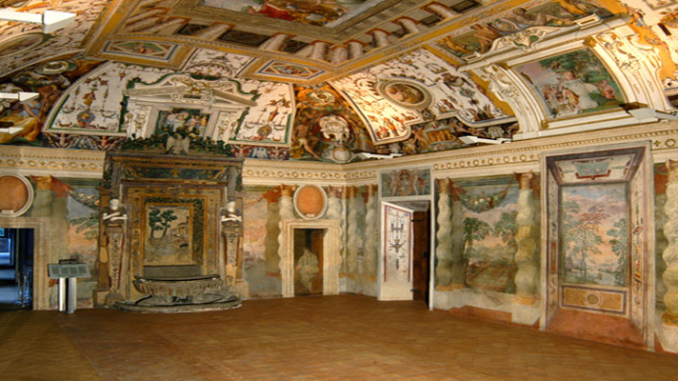
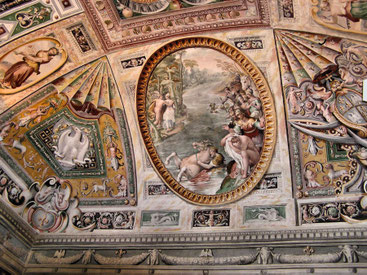
After entering you are welcomed in the courtyard (old cloister) by a Sleeping Venus. The palace has 10 rooms decorated by Livio Agresti, Antonio Tempesta, Cesare Nebbia, Annibale Carracci, Perin del Vega and others representing biblical stories, historical and mythological episodes, result of the education and culture of the cardinal.
The Este coat of arms is the eagle holding the hesperides apples, one of the labours of Hercules witch is Tivoli’s and commercial activities’ protector. The villa has had several special guests: important Popes such Gregory XIII, artists and musicians such as Franz Liszt.

The upper apartment was where the Cardinal lived, including the Room of the Throne, the Library, his Bedroom showing a wooden ceiling by Bolingier, the Chapel. The lower apartment was for social activitues including the Central Hall with its panoramic frescoes and the vault, painted by Girolamo Muziano and Federico Zuccari, representing the Banquet of the Gods; in the corners are representations of Apollo, Bacchus, Diana, Ceres and on one side a fountain decorated with mosaics and a painted view of the Temple of Vesta; on the opposite side is the view of the Villa that shows the villa project in the 1500s.
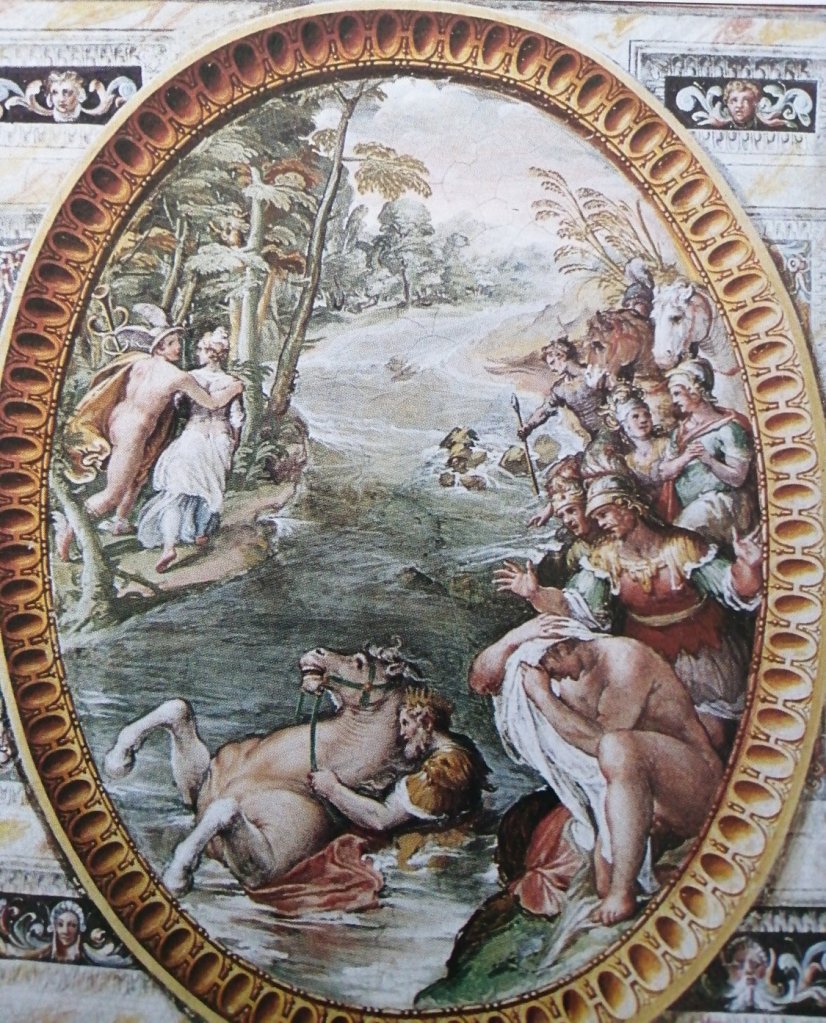

In the other rooms are the frescoes representing: Catillus, general of Evandro’s fleet, approaching Latium; Catillo’s family; the response of the foretellers; the construction of the city walls: the fight against the surrounding populations: the choice of the name Tibur; stories of Tibur, the chariot of Apollo; stories of King Anious and the girl Inone who will become the Sibyl of Tivoli; stories of Noah and Moses; the labours of Hercules; the Hall of the philosophers with the Allegories of Virtues, Sciences, Arts and the busts of some philosophers.

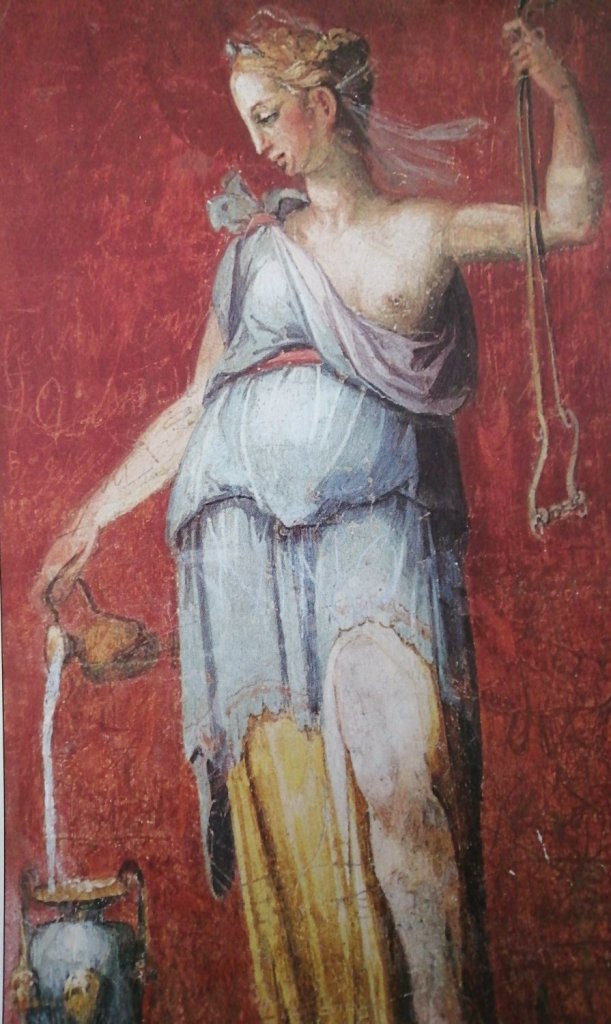
During the Renaissance, period of rediscovery of the ancient times, it is common to find pagan and fantastic figures: it is the result of erudite reflections hiding virtuos meanings connected to the cristian world.
The most famous fountains are:
- Sleeping Venus, at entrance in Piazza s.Maria maggiore
- Fountain of the Bicchierone (big glass, designed by Bernini in 1660 using poor materials)
- Fountain Rometta (little Rome) with statues representing the goddess Roma and its iconic sights.
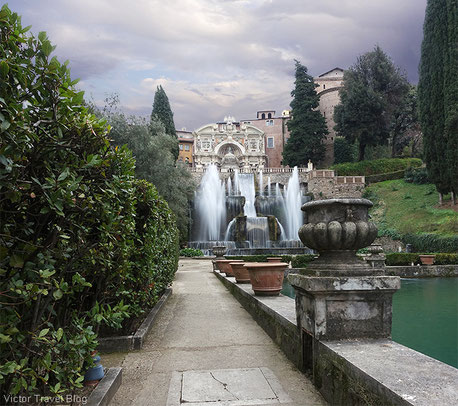
- Viale (Avenue) of a hundred fountains
- Fontana dell’Ovato (oval) or Tivoli with nymph, Sybil and Pegasus
- Fountain of the hydraulic organ, designed by Claude Vernand, produced pleasant relaxing sound using water, pipes and air. It plays from 10.30 every two hours
- Fountain of the dragons, built to honor the visit of pope Gregory XIII in 1572
- Fountain of the night and lowes
- Fountain of Neptune
- Fountain Nature of Artemis from Ephesus
- 3 fishponds
Closed on Monday mornings (it reopens at 2 pm)

Due to its large quantity of water, salubrious air and fertile land, in the ancient Roman times Tivoli was chosed by some important personalities for their villas of cultural activities and meditation (otium) such as Propertius, Horace and the emperor Publius Helios Hadrian who planned a residence away from the hustle and bustle of the Capital.
As an anchitect, he designed a villa which could as well reproduce some of the marvels of his trips and the recall the beauty of the places He visited. The vicinity to the travertine quarries provided enough building material and the surrounding forrests gave the emperor the chance to go hunting.
Throught the twenty years of his principate he dedicated accurate attention at this place that he was able to enjoy here the last 4 years of his life when he stopped travelling.
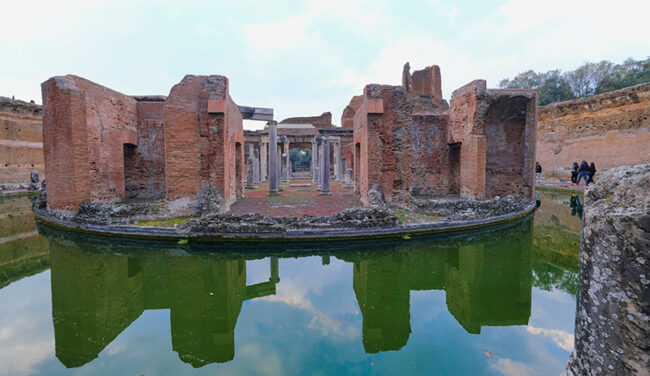
A theater for the music and plays, a reproduction of the stoah (pecile) courtyard of Athens, barracks for the imperial guard (cento camerelle), thermal baths, a library, fishponds, underground tunnels for the servants to move the goods by carriage unseen by those on top, a circular porch (so called ‘maritine theater’) of similar proportion to the Pantheon where Hadrian could isolate, a reproduction of the canal connecting Alexandria to the city of Canopus where his young lover Antinoo drowned.
His desperation for Antinoo’s death was so enourmous that he decided to divinaze him and built hundreds of themples all around the roman empire.
Many statues found here are now hosted at the Vatican and Capitoline Museums. The total extension of Hadrian’s Villa is 120 ectar (300 acres).

Visit the Cathedral of Saint Lawrence (celebrated on August 10th) which was probably chosen because in Ancient Rome Hercules was celebrated on August 12th. In this church is the body of St Generosus killed during the Gothic-Bizantine Wars and Totila’s invasion in 545. Santa Sinforosa is the third patron saint of the city since she is a martyr persecuted with her family by Hadrian.
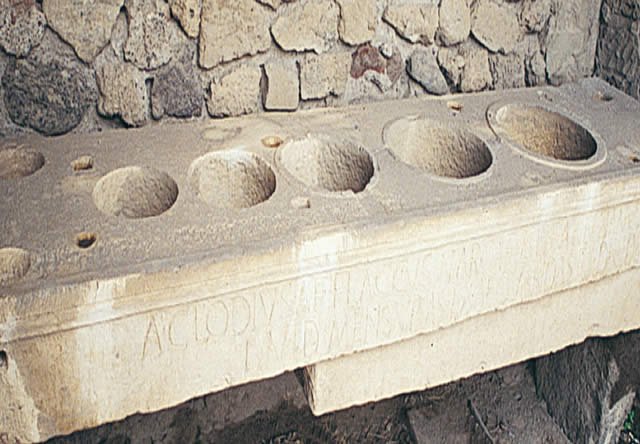
Next to the Cathedral is where the standard weights and measures were stored (mensa ponderaria). They were used to make sure that shopkeepers and traders were effectively selling their customers the correct weight or amount of produce.
Nine round holes in a limestone block situated in a niche on the outer wall of the Temple of Apollo were used as standard measures. Here, under the supervision of the town magistrates, produce was weighed by placing it in the round cavities and then removed via the holes made below the counter.
This public service had already been introduced in the Samnite period, but after 20 B.C. the measures – including three additional ones on a new counter – were adapted to the new parameters of the Roman system of weights and measures, as is explained on an inscription that the Duumviri had engraved on the stone block.
Suggested Restaurant in Tivoli:
La Sibilla overlooking the Aniene waterfalls and the trails down to the Gregorian Villa – closed on Mondays

Suggested Book: Hadrian’s memoirs by Marguerite Yourcenar (1953)
 Maurizio Rome Guide