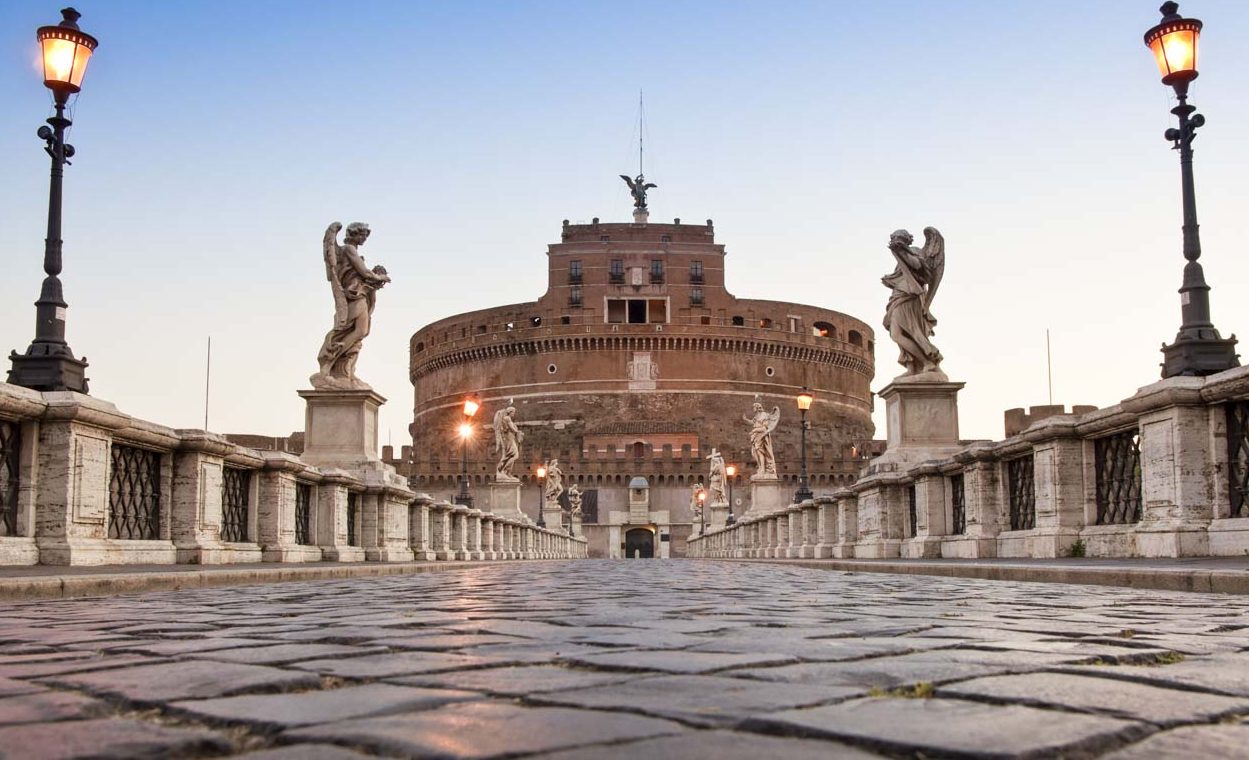

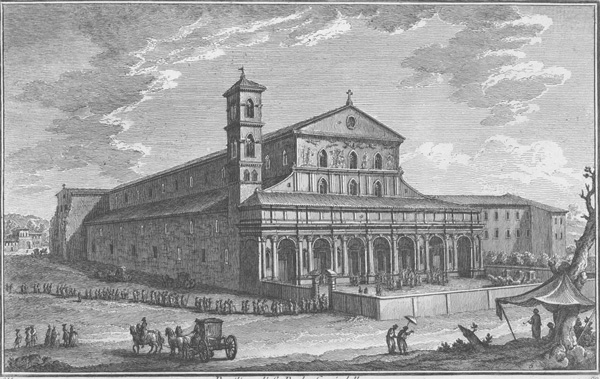
It is one of the four major basilicas of Rome and the only one located outside the ancient walls. It was originally built by the Emperor Constantine by the Necropolis (city od the dead) of Via Ostiense, on the burial place of the Apostle Paul who had been condemned to be decapitated at the current Abbey of the Three Fountains (from the jets of water created by the bounces of the head). It was rebuilt and enlarged considerably , reversing its orientation, by the Emperors Theodosius between 384-6 and Honorius who completed it. It remained practically intact until the terrible fire of July 15th 1823 and whose reconstruction, also thanks to several donations coming from all over the world, took place mostly under Pope Gregory XVI and Pope Pius IX who on December 10th 1854 inaugurated the new Basilica in conjunction with the proclamation of the dogma of the Immaculate Conception (Mary, being the mother of Jesus, was conceived totally pure without the original sin). In the apse of the altar we find the names of the participants to this event that were the College of Cardinals, the Patriarch of Alexandria and 140 bishops.
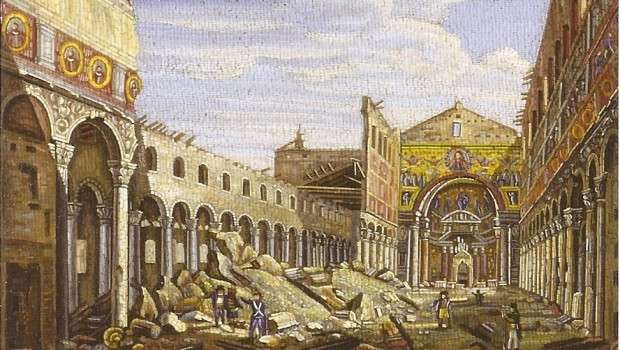
The new project including the bell tower was entrusted to Luigi Poletti, construction manager from 1833 until 1869, the year of his death, flanked by Virginio Vespignani. During the works, important archaeological discoveries were also made. In 1838 Vespignani carried out some reliefs of the ark of Saint Paul and in 1850 the apse of the primitive Constantinian basilica was found.
Paul never met personally Jesus and for long time He actually persecuted the members of the Christian community before having a vision and hearing the voice of God saying “why are you persecuting my people” on the way to Damascus. He fell blind from the horse that he was riding and converted to cristianity becoming a messenger of God to the Pagans.
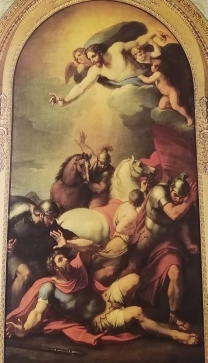
He travelled throughout the Mediterranean Sea spreding the message and forming new communities before being arrested in Jerusalem for troublemaking. As a Roman citizen, he had the right of being judged in Rome but once found guilty of causing social unstability he was beheaded (fast death accorded to Roman citizens) and buried along the roman road to Ostia.

On the facade nineteenth-century mosaics depicting the Prophets Isaiah, Jeremiah, Ezekiel and Daniel with the Lamb of God on the mountain from which 4 streams flow symbolizing the Gospels to which twelve lambs representing the Apostles go to drink with the holy cities of Jerusalem and Bethlehem in the background. From cartoons by Filippo Agricola, the mosaics were made between 1854 and 1874 by the Vatican Mosaic Studio.

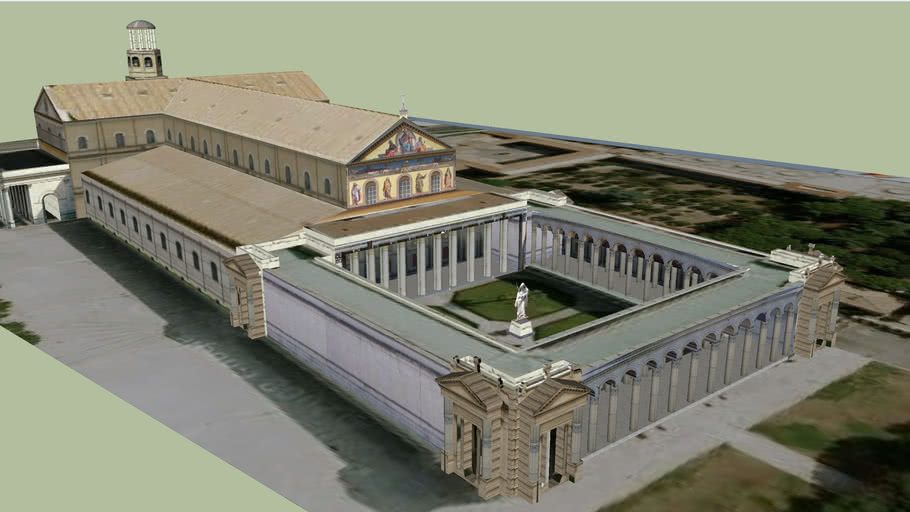
In the four-sided Portico, built between 1890 and 1928 on a project by Gugliemo Calderini, there are 150 columns of white granite from Montorfano and Rosa di Baveno (narthex) 10 meters high. The side walls are adorned with symbolic figures of early Christian origin (vine, doves, globe, deer, peacocks). In the center, the Carrara marble statue of Paul by Giuseppe Obici who was involved with Luigi Poletti in the execution of the Column of the Immaculate Conception in Piazza di Spagna for the proclamation of the dogma in 1854. The statue of San Luca was made in 1893 by Francesco Fabi -Altini also author of that of San Simone in the right aisle.

The Holy Door is usually opened every 25 years and then closed with concrete; on the internal side we find the Byzantine Gate known as Pantaleone, from the name of the commissioner, produced in 1070 by Staurachio di Scio in Constantinople (at the time the artistic capital as well as the most important and populous city in the world) and signed by the Greek artist Theodoro. Partially damaged by the great fire, it was previously the central door of the Pauline Basilica and is made up of 56 panels representing episodes from the life of Jesus, the Apostles and the prophets. Pantaleone was a rich patron who donated it to the basilica, as he had done for the Cathedral of Amalfi and the sanctuary of San Michele al Gargano, and who is represented on it prostrated at the feet of the apostles.
The current main access is the 7.5 meter-high Bronze Door made by Antonio Maraini in 1929 with the ‘exaltation of the preaching of the Apostles’ produced in the aftermath of the 1929 Lateran Pacts which had sanctioned the return of the basilica under the jurisdiction of the Holy See.

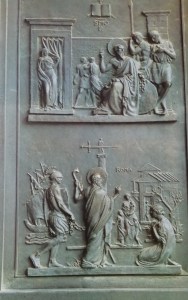
The central silver panels depict the salient encounters with Christ: the delivery of the keys and the conversion on the road to Damascus while in the others the fundamental role of the Eternal City. Proceeding from below we have on the right the episodes of Paul: the saint arrives in Rome welcomed by the Roman faithful; conversion of some Romans; his conversion on the road to Damascus; conversion of the centurion; beheading of the saint. On the right those of Peter: the saint baptizes in the catacombs; foundation of the papal seat; delivery of the keys; “domine quo vadis”; crucifixion of the saint.
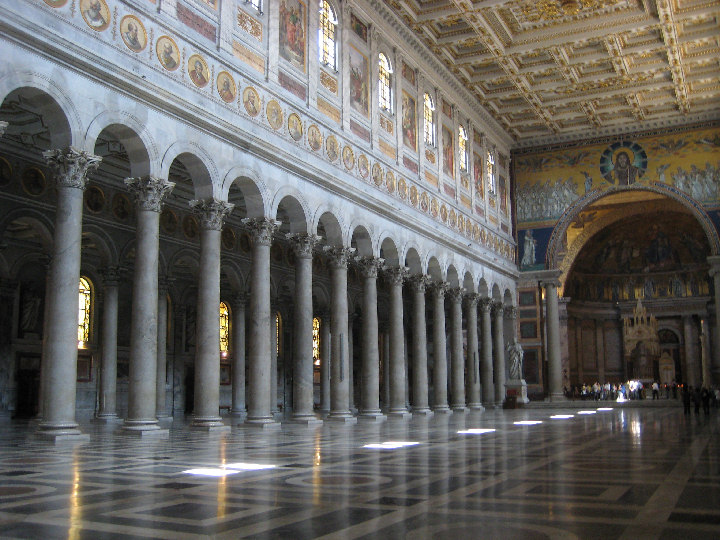
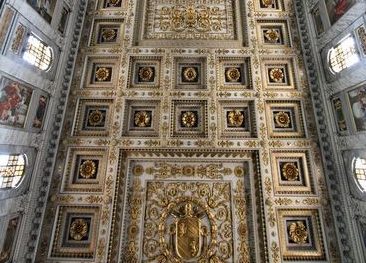
Internally we find 80 Baveno granite columns with Carrara marble capitals, like the original basilica, which divide it into 5 naves making it the second largest in Rome. The neo-sixteenth-century style ceiling in gilded wood was executed in the mid-nineteenth century under Pius IX, the Pope with the longest pontificate (31 years) whose emblem with lions and diagonal bands dominates in the middle surmounted by the keys of St. Peter and the Triregno over the Papal Tiara, consisting of the three authorities of the Pope: as father of princes and kings, rector of the city, vicar of Christ.
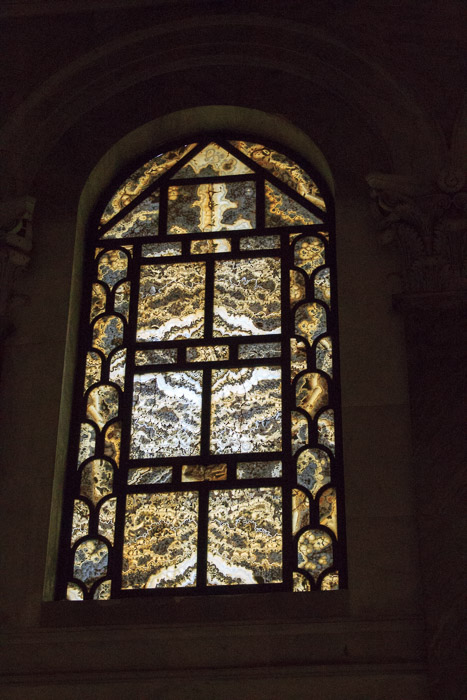

Being the basilica known all over the world, it is not surprising that the alabaster for the windows was donated by the king of Egypt Fuad, the alabaster columns by the viceroy of Egypt and the emerald green malachite by the Orthodox Tsar of Russia. The new San Paolo, in harmony with the work of the Apostle of the Gentiles, became a compendium of liberality and universal wealth which was realized in the precious materials used.
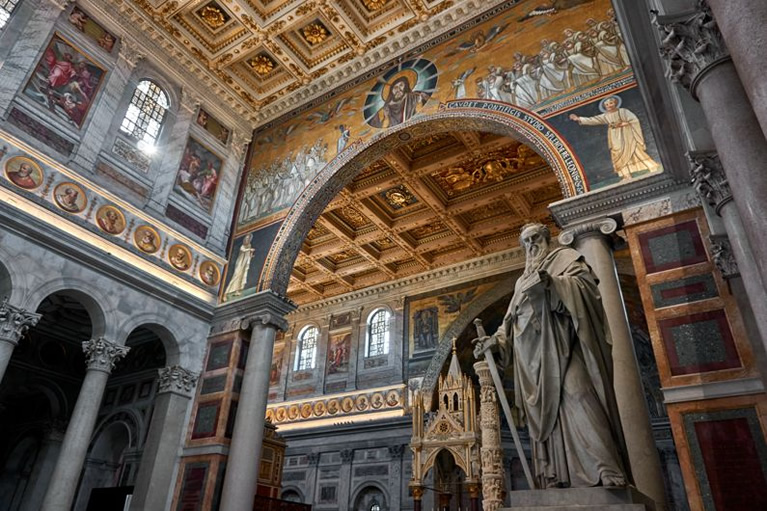
Still under the jurisdiction of the Benedictine monks, on the Ciborium by Arnolfo di Cambio with his signature dating 1285 are remarkable the decorations at the top showing Adam and Eve, Cain and Abel, St. Benedict, St. Peter, St. Paul and St. Timothy follower of Paul, the monk Bartholomew offering the model of the ciborium to St. Paul.

The apsidal mosaics by Venetian workers (1279-81, only partially original) showing the blessing Christ with Peter, Andrew, Paul and Luke with Pope Honorius III prostrating. Under the ciborium is the Tomb of the Apostle Paul while on the triumphal arch, partly original and restored, you can read in the beautiful mosaic financed by Galla Placidia the inscription celebrating the beginning of construction and the conclusion by the Byzantine emperors Theodosius (her father, the one who made cristianity the esclusive religion of the Empire in 380) and Honorius (the one who elevated the roman walls erected by Aurelian) at the time of Pope Leo the Great (5th century). It refers to the body of the ‘doctor mundi‘ and builder of Roman-Catholic theology. In the same are the symbols of the 4 Gospels and the 24 elders of the Apocalypse with the tribes of Israel gathered on the last day. The thirteenth-century mosaics of the rear part, extensively restored, are by Pietro Cavallini and come from the ancient facade of the basilica with the nineteenth-century inscription of Pope Gregory XVI.

Under the altar are the remains of Paul, the doors of the entrance gate are decorated with the heads of Titus and Timothy disciples of the saint. A double staircase in giallo antico (antique yellow) and bronze descends into the Confession where is the porphyry table containing the remains of the martyr Timothy.
In the lunette of the rear niche is the painting ‘Saint Paul kidnapped from the third heaven’ by Camuccini. In the altar of the Conversion are the statues of Saint Bernard and Saint Gregorius.
The medieval 5,60-meter-high Easter Candlestick showing stories from the Passion of Christ (including a scene with a jew being walked over) by Pietro Vassalleto and Nicola d’Angelo is regularly used whereas the Papal Chair by Pietro Tenerani with the ‘handing over of the keys’ from Jesus to the first Pope Peter (tibi dabo claves) dates back to the 19th century.

In the transept are the Chapel of the Assumption of Mary with a 1867 mosaic from an original by Giulio Romano based on a drawing by Raphael contained in the Vatican Museums and the Chapel of the Conversion of Saint Paul with a nineteenth-century canvas by Vincenzo Camuccini. The malachite and lapis lazuli that decorate them are a gift from Nicholas I, Tsar of Russia.
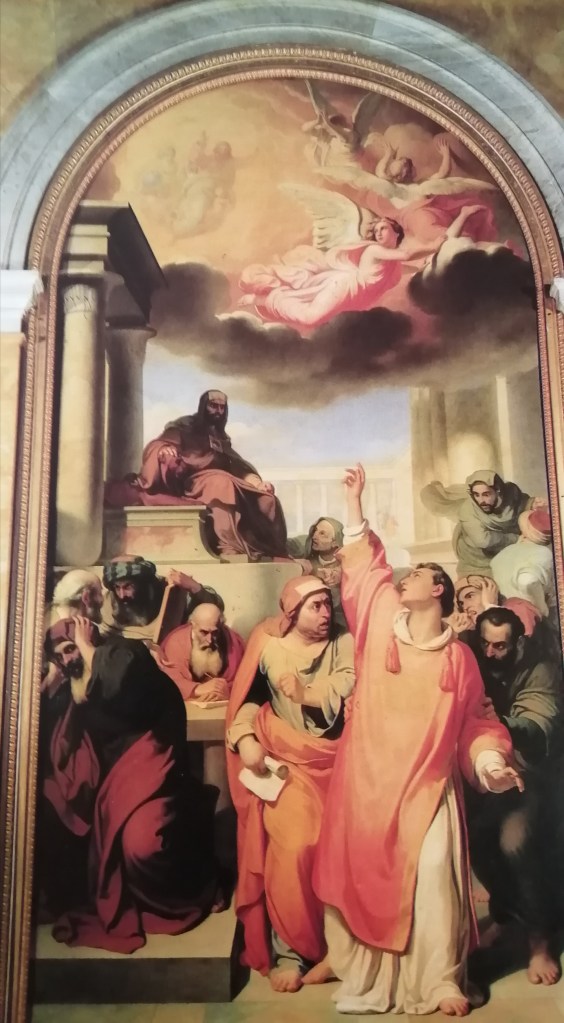
In the Chapel of Saint Stephen is the altar with two red-porphyri columns and the oil-paintings representing the saint condemned by the Sanhedrin (left) by Francesco Coghetti and the stoning of the proto-deacon and martyr (right) by Francesco Podesti who both participated to the stories of Paul along the central nave. It seems from the Acts of the Apostles that Paul met Stephen in this occasion.
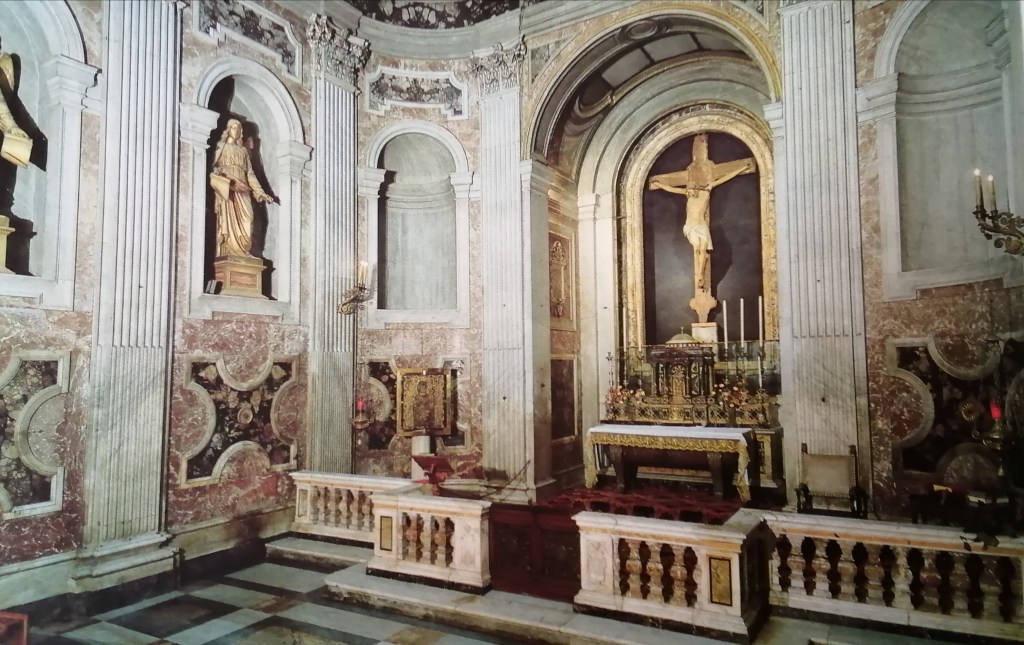

The Chapel of the Crucifix or of the Blessed Sacrament was saved from the fire and is a 17th-century project by Carlo Maderno, also architect of the facade of Saint Peter. Inside is the statue by Stefano Maderno representing Saint Brigida having an ecstatic abduction in front of the 14th-century wooden crucifix attributed to Pietro Cavallini, buried in this basilica. The tradition says that in 1370 the crucifix turned his head as she was praying. On the right the venerable wooden statue of St. Paul with missing pieces detached from the faithful as relics while on the left the 13th-century Byzantine Icon representing the venerated Mother of the Lord who inspired here Ignatius from Loyola the foundation of the Jesuit order on April 22nd 1541.


The Chapel of Saint Lawrence, redecorated after the fire, houses the beautiful choir designed in 16th-century style by Guglielmo Calderini and inlaid by Alessandro Monteneri. In the lunettes are episodes from Lawrence’s life by Antonio Vigiliardi: meeting with Pope Sixtus; distribution to the poor by the Church; glory of the saint. Behind is the 15th-century marble triptych with Saint Anthony Abbot, Saint Denis and Saint Giustina previously placed in the counter-façade.

In the Chapel of Saint Benedict is the 19th-century sculpture of the saint holding the pastoral and the Rule by Pietro Tenerani, a sculptor close to Canova and Thorvaldsen. Ancient gray marble columns from the Etruscan city of Veio in northern Latium were donated by Pope Gregory XVI, founder of the Etruscan and Egyptian museums in the Vatican. This chapel is dedicated to the founder of the oldest western monastic order that has resided here for centuries.

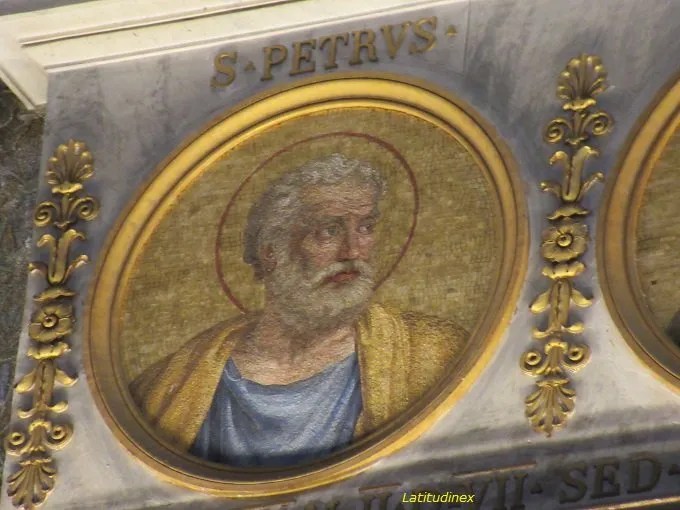
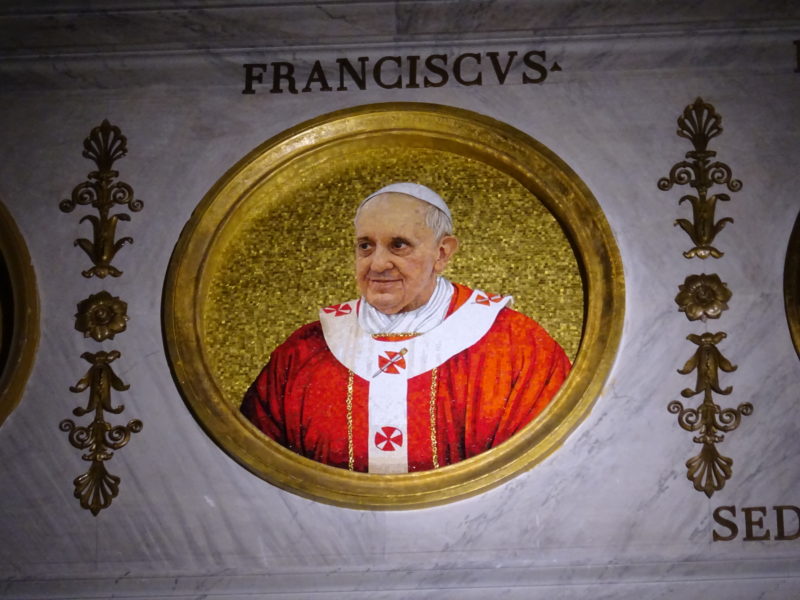
The Papal Portraits in mosaic inside are a remake of the famous frescoed series in the ancient basilica begun in the fifth century by Pope Leo the Great of which only 41 portraits remain preserved in the Abbey. Carried out by the Vatican mosaic school, the works were designed by a series of painters who later also worked on the cycle of frescoes with Stories of Saint Paul including Bompiani, Canterani, De Rossi, Tojetti, Podesti.


The Basilica measures 128×65 meters (second in size in Rome after Saint Peter’s), is 30-meter high, divided into 5 naves and has 36 frescoes by 22 artists representing the main life episodes of the apostle Paul: Baptism of Paul by Ananìa (Francesco Podesti), Conversion (Pietro Gagliardi), Arrival in Rome (Carlo Cavardini), Meeting between Peter and Paul in prison (Pietro Coghetti ), expulsion of Paul from the temple (Pietro Grandi).
In the north head of the transept which is configured as the second facade of the basilica opens the Gregorian Portico with the 12 original columns in Greek marble that survived the fire and surmounted by modern corinthian capitals. Other twelve of pavonazzetto and pink granite were reused for the interior decoration even if the restoration work made those in the first row completely unrecognizable. The first column on the right of the second row bears the famous dedicatory inscription of Pope Siricius referring to the construction of the Theodosian basilica.

The 1930 Baptistery by Arnaldo Foschini has an equilateral cross plan with a cross placed at the level of the ancient basilica. The walls are adorned with very precious marbles (breccia of Egypt, cipollino, alabaster, pavonazzetto, giallo di Siena) and the baptismal font with malachite, lapis lazuli and mother pearl.
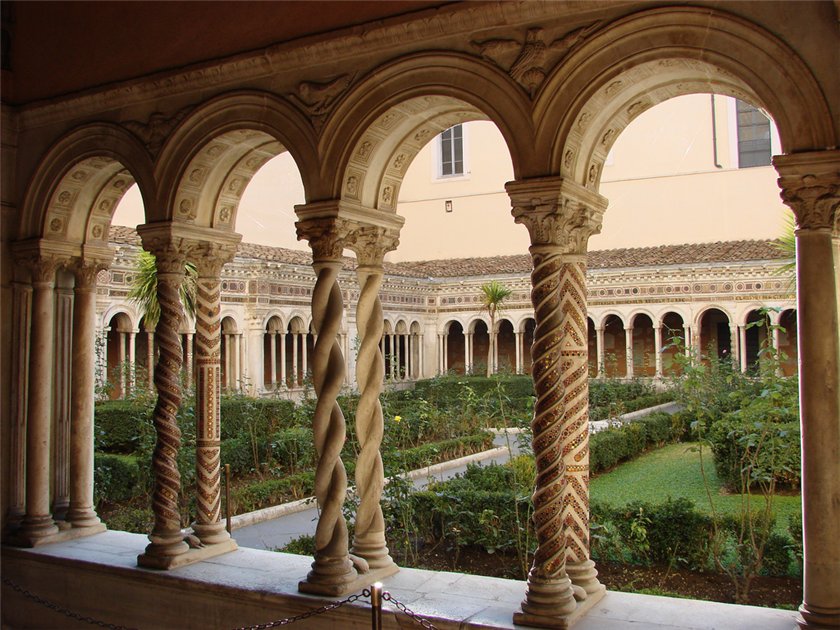
In the Sala del Martilorogio (martyrs’ room) we find fragments of 12th-century frescoes that survived the fire depicting holy martyrs and the Crucifixion with Mary and Magdalene. Beside is the wonderful 13th-century Cloister of Magister Pietro Vassalletto with valuable zoomorphic and phytomorphic representations of ancient classical tradition. The Latin inscription illustrates the purpose of the place (Hic studet atque legit monachorum cetus et orat = Here the class of monks studies, reads and prays) and the role of the monks in the Middle Age.
Along the external archaeological walk fragments of the remains of capitals and columns and in the back of the basilica, dominated by the bulk of the Bell Tower, between the basilica and the abbey is the entrance to the Gregorian Room erected by Pius IX in 1846-47 to facilitate the access of pilgrims from the countryside.
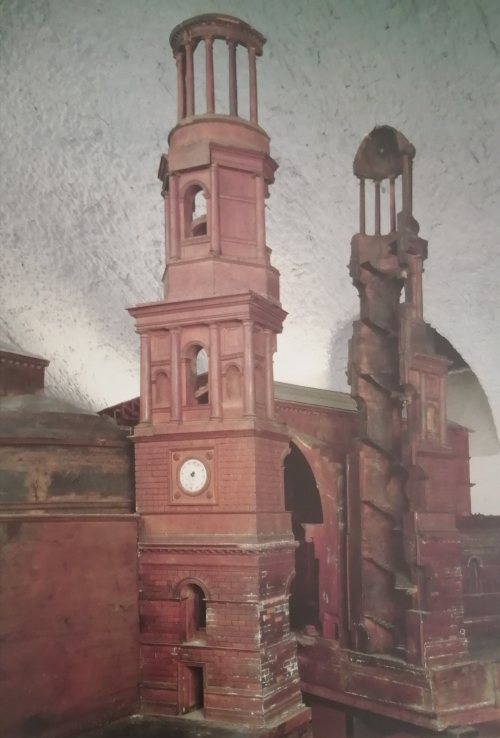
Luigi Poletti’s Bell Tower is 65-meter high and was built between 1840 and 1860 with an internal spiral staircase leading to the top where we find a circular temple crowned by a globe and a cross. The first two floors form the base of the remaining three where we have the sequence of the three geometric shapes square-octagon-circle to which the Doric-Ionic-Corinthian orders correspond.
Pope John XXIII inaugurated the Second Vatican Council in this Basilica in 1959 for a great renewal of the Roman Catholic Church which will lead, among others, to the abandon of Latin language during the mass for a greater approach towards the faithful from all over the world, right in the place where the apostle of Jesus’ message to humanity rests.
Surving works of art: bizantyne gate, part of the apse mosaic, icon of Mary and Jesus, ciboryum by Arnolfo di Cambio, wooden crucifix and statue of St. Paul, statue of Pope Bonifacius IX, easter candlestick & cloister by Pietro Vassalletto
 Maurizio Rome Guide