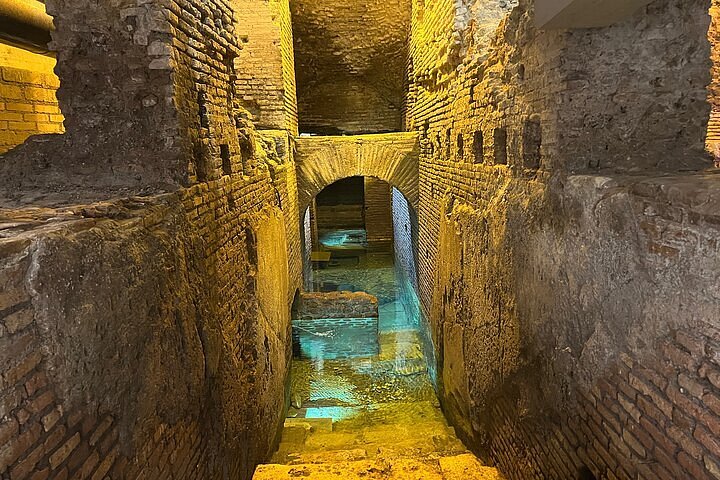
Vicus Caprarius (by the ancient niche with image of a goat) is located 9 meters below the current level and came to light during the renovation of the Trevi Cinema between 1999 and 2001 by the current owner, Cremonini Group. Archaeologists found an insula built under Nero as a testimony of the Nova Urbis that he wanted to build after the fire of 64 AD. Later in the third century AD, the structure was converted into a Domus for an important Roman personality with a water supply pipe from the distribution depot (castellum aquae) of the virgin aqueduct, the only one that has remained in continuous operation since 19 BC. The literary sources documented the existence of 18 castella along the urban trait of this aqueduct which was sponsored by Marcus Agrippa to bring water to the first public Baths located behind the Pantheon.
The aqueduct originates from the south-east of rome, on the 8th mile of Via Collatina, near Salone. It’s there that, according to the legend, Agrippa’s soldiers found a spring thanks to the directions of a maiden. A virgin, indeed, according to the curator aquarum Sextus Julius Frontinus who reported this episode. According to another version, the name derives from the incredible purity of this water. The aqueduct reached Villa Borghese and the Piancian Hill where there is a piscina limaria, a tank for settling water by Trinità dè monti, before continuing on visible arches towards the Campo Marzio. The system works simply by gravity with a difference of only 5,69 meters between the spring and the final point and an overage slope of 30 cms per kilometer.
Some of the rooms of the former insula were turned into a water tank during the age of Hadrian (123 AD) with a hydric capacity of 150.000 liters. The thickness of both the floor and the walls had to be doubled in order to endure water pressure and a thick layer of hydraulic plaster made the walls waterproof. Two ducts are still visible: the biggest had public functions, the smallest (lead pipes) had private functions and can be considered a privilege for few.
Thanks to the discovery of ancient Roman brick stamps, it was possible to set a precise date to the different construction phases that chracterized the history of this place.
In the second half of the fifth century, a fire destroyed most of the decorations in the domus and after the fall of the roman empire, the intensive urbanization of the ancient times was slowly replaced by small rural settlements that reused what had remained of the pre-existing buildings. The medieval sections here date back to the 12th and 13th centuries and are characterized by irregular wall textures. .
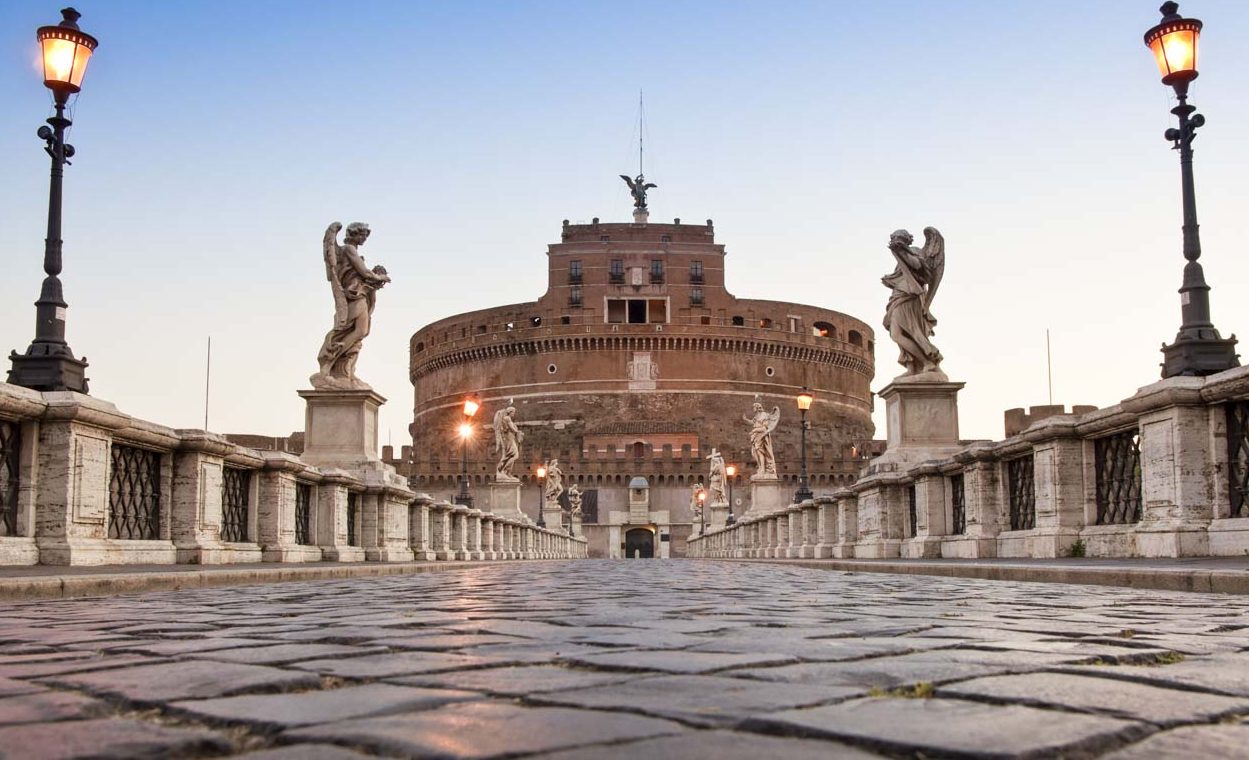
Built by Agrippa in the 1st century BC, the Aqua Virgo provided the necessary water for the first public baths in Rome and was restored in the 16th century even if the underground arches now only reach the current Piazza Trevi where in the eighteenth century the architect Nicola Salvi designed the famous Trevi Fountain. Precisely the water that fed the lead pipes still perfectly preserved in situ and that which, filtering through the ancient walls, has flowed for centuries in the rooms and tubs of a luxurious mansion.
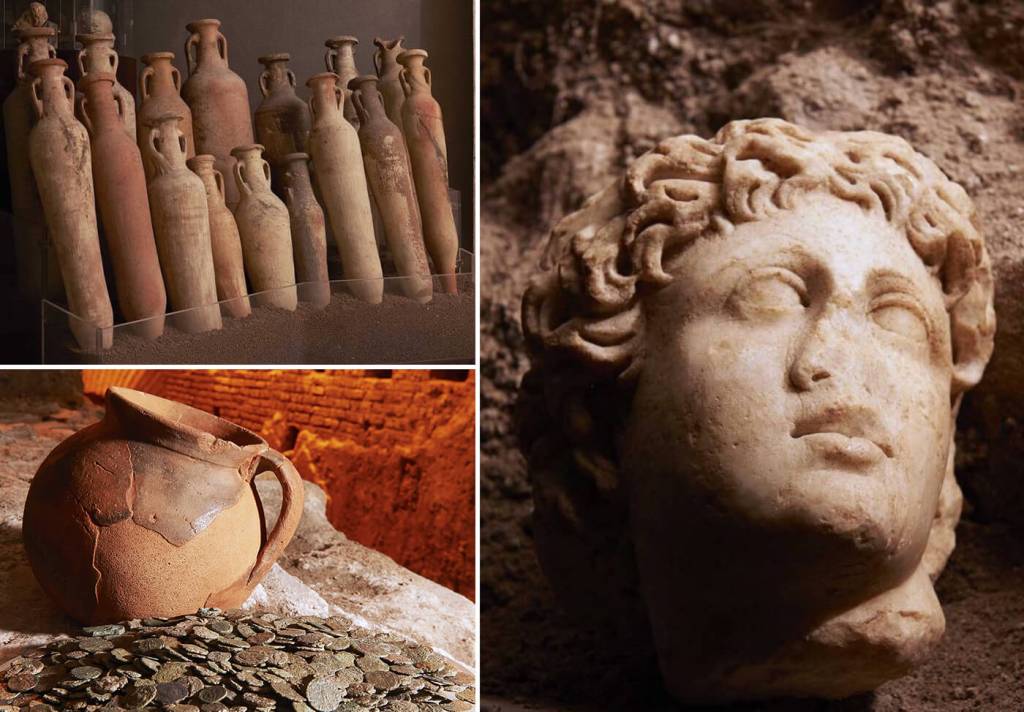
Inside the antiquarium we find various interesting finds such as the bust attributed to Alexander Helios, son of Cleopatra and Marco Antonio, pottery from the Middle Ages when it was built over the ancient buildings, over 800 coins of the IV-V century. A.D. and several amphorae of African origin containing mainly oil. Visible in the museum section is a statue of the deceased (for veiled hands) from the sepulchral area, a falcon representing the Egyptian divinity Horus, a mortar, lanterns, decorative fragments and a part of the colored mosaic floor of the domus which suffered a fire in 455 during the siege of the Vandals to the city. Until the first century the mosaics were in black and white then gradually they will acquire colors thanks to the Roman conquests of new territories and their respective mineral resources. In the adjacent museum room, objects from the Middle Ages.
VICUS CAPRARIUS is open from Tuesday to Sunday between 11am and 5pm. Reservations required https://www.vicuscaprarius.com/
 Maurizio Rome Guide