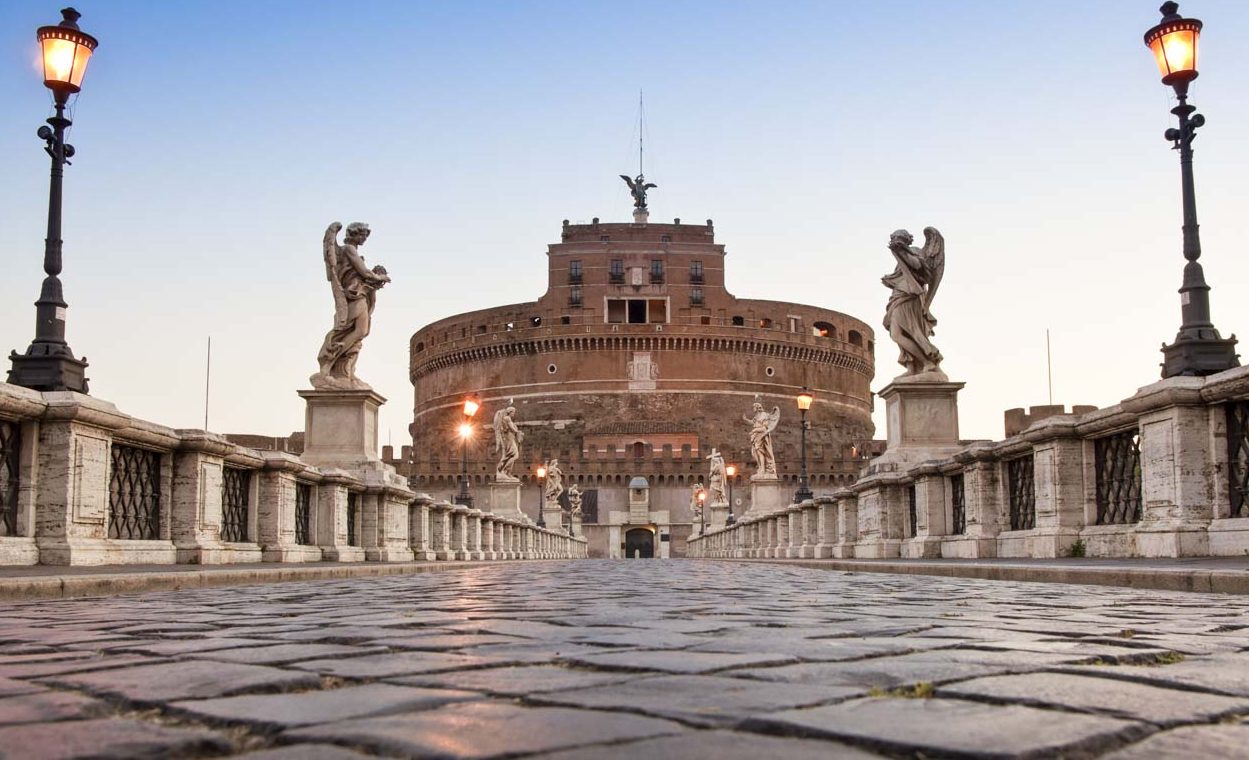
Rome is truly the synthesis of the entire ancient world: the arches and domes derived from the Etruscans, the column styles from the Greeks, the obelisks from the Egyptians.
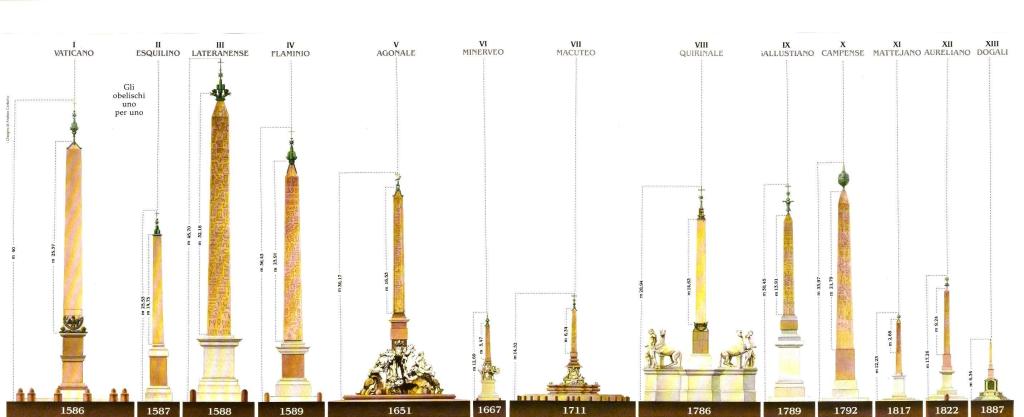
The word obelisk comes from the Greek word Obelos meaning ‘skewer, a petrified sunray’ and was used as a sundial by measuring the length of the shadow cast on a pavement line where specific symbols were marked.
When Egypt became a Roman Province in 31 BC, many of them were gradually embarked and transported to the Capital to be located in the main places of sociality. After the fall of the Empire many of them were abandoned and only since the end of the sixteenth century, thanks to Pope Sixtus V, they were rehabilitated. They christianized with a cross on top, representing the bond with the ancient civilizations and helping pilgrims identifying the most important religious locations: a sort of religious GPS!
THE LATERAN OBELISK
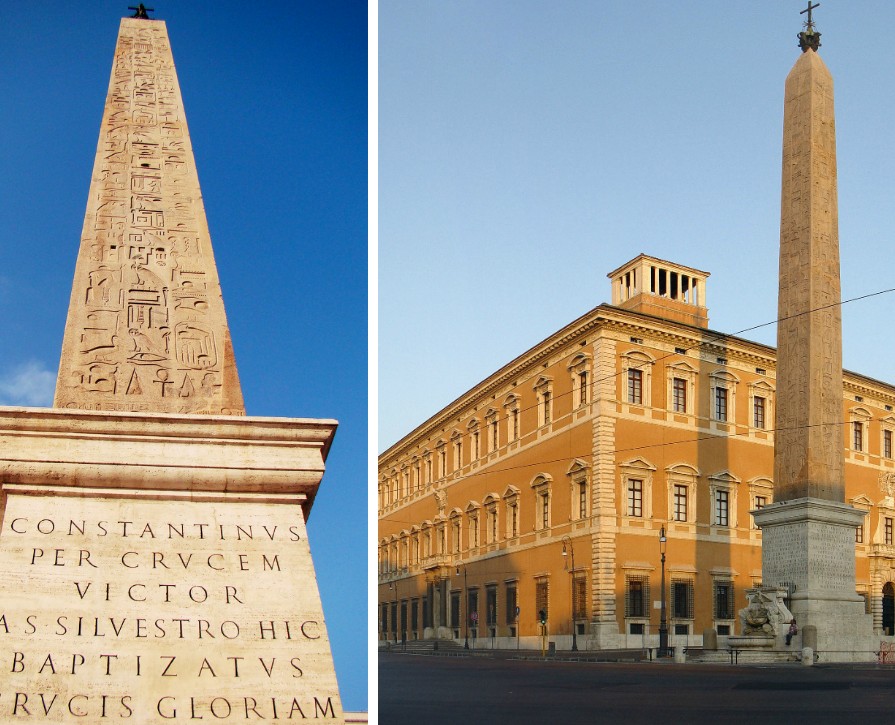
Located in Piazza di San Giovanni in Laterano, near the basilica of the same name, the Lateran Obelisk is today the highest erected of Egyptian origin in the world. It is made of red granite and definitely comes from the Aswan area. Its height is 32,18 meters and, including the cross and the base, it reaches 45,70 meters. It weighs 455 tons. It was the last obelisk to be brought to Rome.
It was built under Tutmosis III (1481 BC – 1425 BC), Pharaoh of the XVIII dynasty of Egypt and stood in front of the temple of the god Amon in Karnak.
The sides are decorated and, among the various inscriptions on the upper part, an image of the pharaoh in the act of making offerings to the divinity is engraved inside a box. Other inscriptions recall that its decoration took 35 years of expert craftsmen’s work.
The grandiose obelisk was transported, by order of the Emperor Constantine (274-337 AD), along the Nile as far as Alexandria. The death of the emperor (337) interrupted the continuation of the transport to Rome. The enterprise was completed, after various vicissitudes, by Constantine’s son, Flavius Constantius II, in 357. Thanks to a grandiose ship, built for the occasion and moved by 300 rowers, the obelisk arrived at the port of Ostia. It was dragged along the Tiber by an immense raft, then placed on solid wagons and taken to the Circus Maximus, where it was erected alongside the Flaminian Obelisk (now in Piazza del Popolo) brought to Rome by Augustus three centuries earlier.
Being the first great monument erected in Rome after the affirmation of Christianity, it soon became the symbol for the Roman population of the victory and supremacy of the new religion over paganism.
About a century later it fell, perhaps following an attack, and only in the sixteenth century, by order of Pope Sixtus V who also offered a prize to those who found it, it was found under 7 meters of earth and mud, broken into 3 sections.
The Pope had it restored and erected on the Lateran square in place of the equestrian statue of Marcus Aurelius which was placed on the Piazza del Campidoglio.
In 1588, the architect Domenico Fontana restored it and equipped it with a new marble base; on the top he placed a cross and the heraldic symbols of the Pope’s family, surrounded by 4 lions made by Ludovico del Duca.
The Lateran Obelisk, embellished with a beautiful seventeenth-century fountain, was inaugurated on August 3rd 1588.
Vatican Obelisk
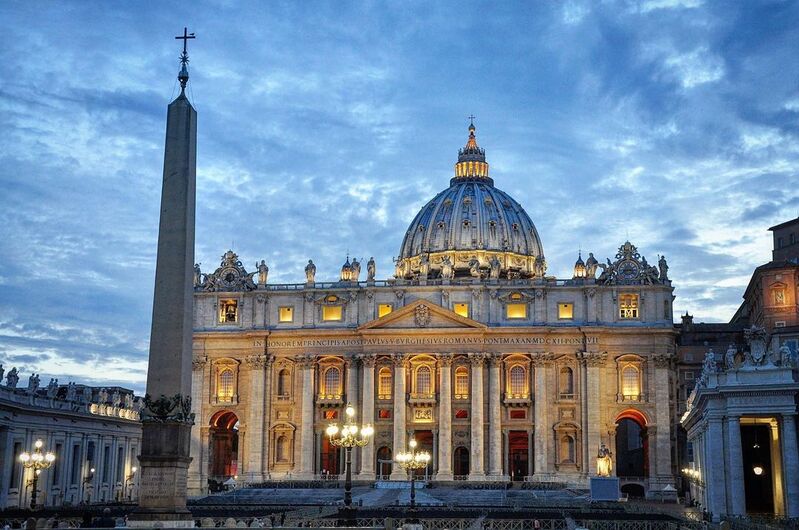
Located in St. Peter’s Square in front of the homonymous Basilica and Bernini’s colonnade, the Vatican Obelisk is among the 13 ancient obelisks that adorn Rome.
Carved out of red granite, it stands for 25,36 meters; with the base and the cross it reaches 40,28 meters. Together with the obelisks in piazza dell’Esquilino and piazza del Quirinale, the Vatican Obelisk has no decorated sides and bears no inscriptions, perhaps because they were brought to Rome unfinished, directly from the excavation site, or due to the sudden death of the Pharaoh Nencoreus who had commissioned them for Heliopolis.
Originally it must have reached 45 meters, but it probably broke during the erection, on the orders of Augustus, in the Forum Julius of Alexandria.
In 37 AD, the Emperor Caligula ordered his transfer to Rome, where it was raised in the Circus of Caligula and Nero. According to the tradition, many Christians were martyred here, including St. Peter. The fact that, unlike the others, this obelisk has always remained standing, is attributed precisely to the importance it had for the people who considered it a witness of such mournful events. And it is also certain that, given its proximity to the old Constantinian Basilica, if it had been demolished, it would have risked crashing on it.
From the place of its first Roman location, it was moved following the nearby works for the construction of the new St. Peter’s Basilica in the 1500s. After several unsuccessful projects, the transport to the center of the square was carried out thanks to the will of Pope Sixtus V who entrusted the grandiose project of elevation directly to the architect Domenico Fontana (1543-1607).
The maneuvers turned out to be very complicated and to carry them out, given the substantial weight of the obelisk (327 tons) Fontana used the help of 900 men and 75 horses who had to work in religious silence, on penalty of death.
During the operations to hoist the obelisk, the now famous cry of the sailor Benedetto Bresca rang out: “Water to the ropes!”: The ropes to which the monolith was secured were yielding under its considerable weight, wet with water, strengthened and the enterprise was successfully completed. The phases of the cumbersome transport are illustrated not only in Domenico Fontana’s “On the Transport of the Vatican Obelisk” (1590), but also in a large number of contemporary engravings, as in a modern reportage. The audacious project ended before the end of the work on St. Peter’s Basilica and about 100 years before the construction of the colonnade by Gian Lorenzo Bernini.
On the occasion, the contents of the globe placed on its top – now preserved in the Capitoline Museums – which was believed to contain the ashes of Julius Caesar were also examined. Inside, however, nothing but dust was found. On the sphere you can still see the marks of the balls of the arquebuses which, in 1527, the Lanzichenecchi shoot at it during the sack of Rome.
The Vatican Obelisk is separated from its base by four lions that recall the coat of arms of Pope Sixtus V, the work of Prospero Antichi and, unlike the others, it does not rest directly on it. It is crowned with a cross that surmounts the heraldic symbols of the family of Pope Sixtus V Peretti.
The relocation to St. Peter’s Square, which took place without any accident and in a very short time, was anxiously followed by the whole population who brought Domenico Fontana to triumph on the last day. The obelisk was erected “in the setting of the Sun” on September 10th 1586.
Flaminian Obelisk
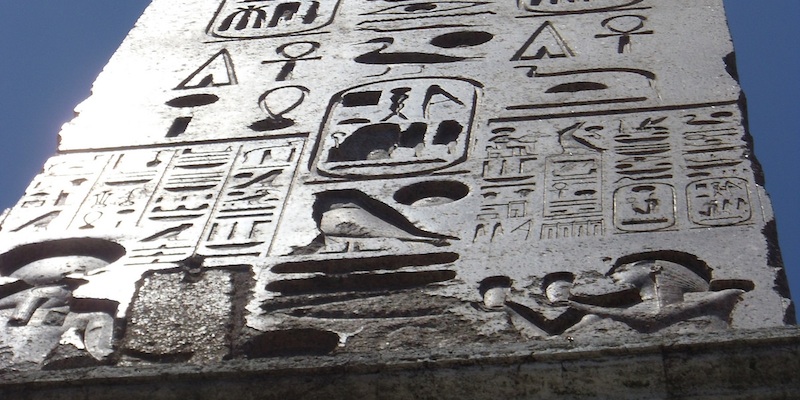
Located right in the center of the famous Piazza del Popolo, the Flaminian Obelisk is one of the most important obelisks in the city and the first to be brought from Egypt to Rome. The operation was of such grandeur that even the ship used to transport it was exposed to the public for years.
Built around 1300 BC, to be placed in the temple of the Sun or Ra of Heliopolis in Egypt, it has a height of 23,91 meters and, with the base and the cross, reaches 36,43 meters. Carved from a single block of red granite, its sides were decorated with hieroglyphs by order of the pharaohs Seti I and his son Ramses II.
In 10 BC, together with the Campense Obelisk, which is located in the square of Monte Citorio, it was placed on the spine of the Circus Maximus to commemorate the conquest of Egypt by Octavian Augustus. Three centuries later it was followed by the Lateran Obelisk. It represented the Sun with the chariots running around it representing the planets!
In the fourth century it was still standing but later the memory was lost for about a millennium. In the sixteenth century some fragments were found, but it was only during the pontificate of Pope Sixtus V that a serious search and excavation campaign was undertaken for its recovery.
After the unsuccessful attempt to give the obelisk to the abbot of San Paolo fuori le Mura so that he could adorn the basilica and the unsuccessful project to use it to decorate the basilica of Santa Croce in Gerusalemme, it was chosen as the square destination del Popolo, where it was erected in 1589.
The rebuilding in that place served to underline the great importance of the square, monumental access to the city from the North, shortly after Pope Sixtus V had established, with a bull, that the basilica of Santa Maria del Popolo was considered one of the “seven churches” that pilgrims had to visit in Rome, to replace the Basilica of San Sebastiano fuori le Mura, which was considered too out of the way.
Until 1589, the only ornament of the square was the fountain commissioned by Pope Gregory XIII. Over the centuries, the space underwent various modifications, assuming its current structure only at the turn of the eighteenth and nineteenth centuries. Consequently, the arrangement of the obelisk also underwent changes: in 1823, by order of Pope Leo XII, the great architect Giuseppe Valadier endowed it with a raised base to which the Egyptian-style lion-shaped fountains were added at its feet.
Today, it is the crowning glory of the three streets that converge on the square from the south – the so-called “Trident” – and the general layout constitutes one of the most splendid arrangements of an obelisk in the world.
Obelisk in Montecitorio (Campense)
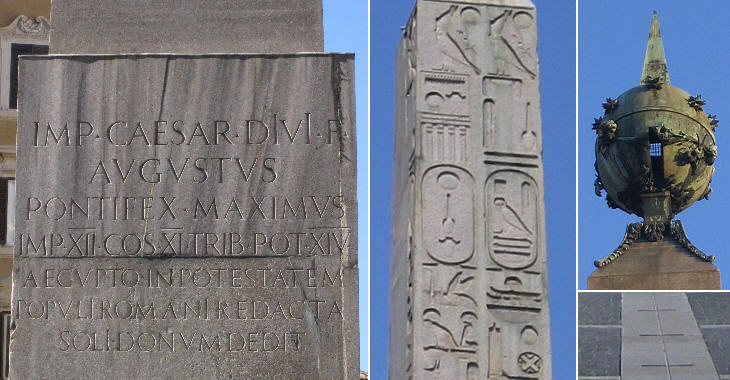
Located on Piazza di Monte Citorio, in front of the Chamber of Deputies of the Italian Republic, the Campense Obelisk, together with that of Piazza della Minerva, dates back to the Saitian Dynasty (XXVI), which goes from 672 to 525 BC. Pharaoh Psammetich II ordered its erection in the original site of Heliopolis in the attempt of reviving old Egyptian glory.
Made of red granite, it has a height of 21,79 meters (33,27 meters with the base and the globe).
It was brought to Rome by Augustus in 10 BC together with the Flaminian Obelisk and was erected in Campo Marzio on a pedestal with a dedication to the emperor: “IMP CAES DIVI FIL AUGUSTUS PONTIFEX MAXIMUS IMP XII COS XI TRIB POT XIV AEGYPTO IN POTESTATEM POPULI ROMANI REDACTA SOLI DONUM DEDIT” (“Emperor Augustus, son of the divine Caesar, pontiff maximum, proclaimed emperor for the twelfth time, consul eleven times, who held the power of the tribunal fourteen times, having led Egypt into the power of the Roman people, gave as a gift to the Sun ” ).
The area at the foot and around the obelisk was paved with a mosaic depicting the winds, signs of the zodiac and a sundial. It was probably the gnomon of the sundial which is the part that casts the shadow.
The Campense Obelisk remained standing until the tenth or eleventh century but perhaps due to subsidence of the ground caused by earthquakes or floods it collapsed and was progressively buried and its memory was lost.
Its astronomical function, however, aroused great interest for scholars and collectors; for this reason it was sought with great care and, after various unsuccessful attempts, it was finally found and, in 1748, Pope Benedict XIV ordered its extraction.
It turned out to be broken into five pieces and badly damaged by the fire. The extraction and restoration work was entrusted to the engineer Antonio Zabaglia, an uneducated person but with a great talent for mechanical works. Another 40 years had to pass and finally, in 1792, the obelisk was placed in its current position, thanks to the work of architect Giovanni Antinori.
It was restored in 1965 and, in 1998, the square was rearranged, recreating the zodiacal elements in the pavement and the guidelines that give the obelisk its function as a sundial indicator.
Given the poor conditions of conservation, many of the inscriptions have been lost and only a list remains with the names of the pharaoh and an interpretation of natural phenomena according to the philosophy of the Egyptians.
Agonal Obelisk in Piazza Navona
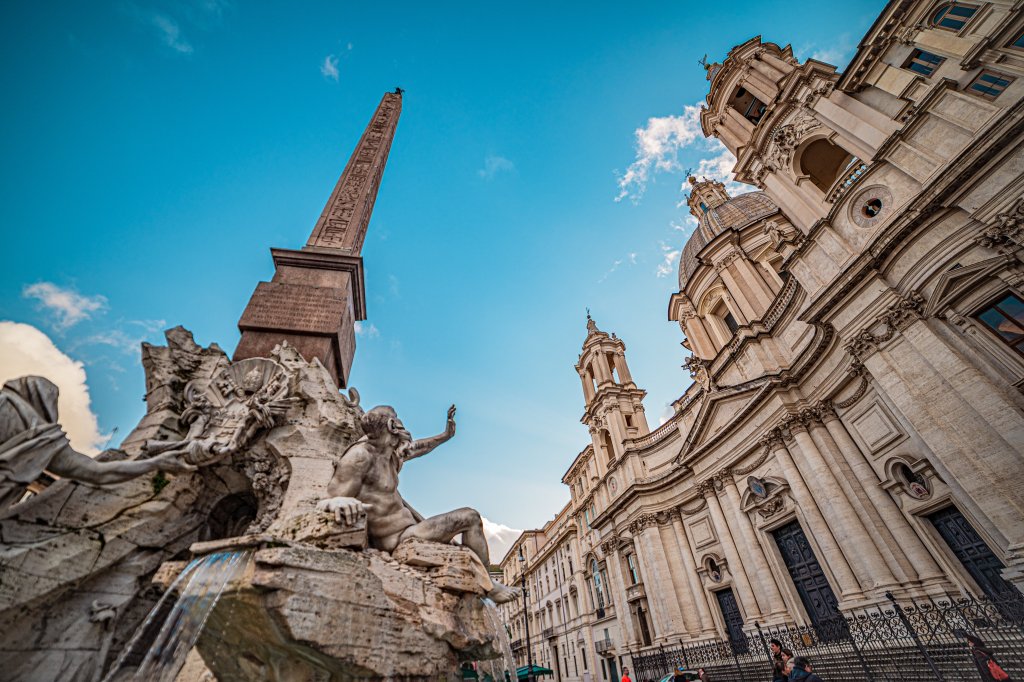
Brought from the excavation sites of Aswan without inscriptions by order of Domitian, this obelisk was decorated in Rome with original inscriptions written in hieroglyphics and with a representation of the emperor between two deities. It is made of granite and is 16,53 meters high (totally 30,17 meters). It was placed between the temples of Serapis and Isis, where it remained for over two centuries until Maxentius had it placed in his Circus, along the Via Appia, built in memory of his son Romulus who died in 310. It is not known when he fell but it is certain that his re-erection is due to Pope Innocent X Pamphilj in the mid-1600s, who chose Piazza Navona to indicate his birthplace and family residence.
In addition to the obelisk, however, the square should have housed a grandiose fountain which was to constitute the real “exhibition”, that is, the final prospect of the Aqua Vergine aqueduct. In fact, the Trevi Fountain had not yet been built, due to lack of funds. The pope had entrusted the work to others, but Bernini succeeded by means of a stratagem, by donating a silver model to Donna Olimpia Maidalchini, the pope’s sister-in-law, to show his splendid project to arrange the obelisk above the Fountain of the Four Rivers. The pope, enthusiastic about the project, immediately entrusted Bernini with the task of carrying out the project which happened between 1647 and 1651.
The inscription on the pedestal recalls the details of the undertaking as well as the meaning of the fountain on which the obelisk rests. The dove on the summit is the symbol of the Pamphilj family. This large composite monument was not received at the time by the Romans with great favor as taxes were even increased due to the high cost of its construction. Today it is one of the most admired and loved monuments of the city.
Esquiline Obelisk
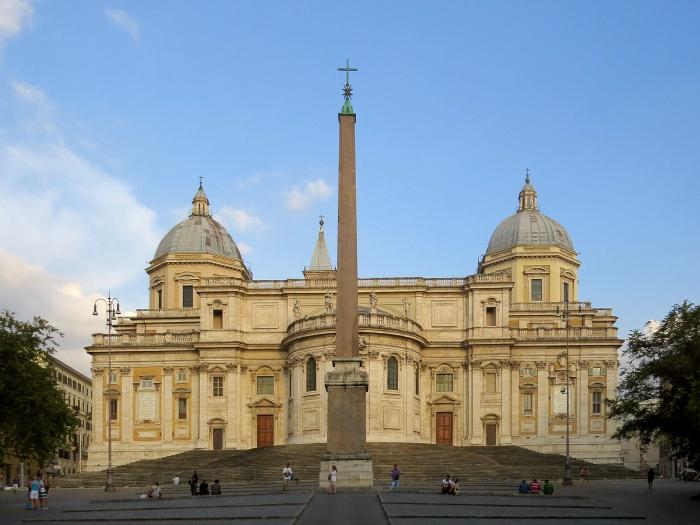
The Obelisk, also called Liberiano, stands in Piazza dell’Esquilino behind the apse of the Basilica of Santa Maria Maggiore, in the Rione Monti.
Carved in the red granite of Aswan, it is 14,75 meters high and with the base and cross it reaches 25,53 meters.
The Esquiline Obelisk is probably of Roman manufacture as it has no inscriptions that also prevent its dating. Perhaps it was built at the time of Domitian in imitation of the Egyptian obelisks or perhaps it dates back to the fourth century BC and was simply transported to Rome from Egypt.
Originally, it was placed, together with the twin Quirinal Obelisk, in the Campo Marzio district at the entrance to the Mausoleum of Augustus, the largest circular sepulcher known.
Fallen into disrepair and buried during the early Middle Ages, its remains, divided into four sections, were found in the 16th century near the Church of San Rocco in Via di Ripetta.
In 1587, at the behest of Pope Sixtus V, who decided to erect an obelisk in front of every basilica in Rome to decree the victory of Christianity over paganism, and on a project by Domenico Fontana, with the collaboration of his brother Marsilio and his nephew Carlo Maderno, was raised again and placed where it is today.
On its top the coat of arms of the family of Pope Sixtus V (Felice Peretti) was placed, the three mountains with the star surmounted by the bronze cross, made by the sculptor Giacomo Tranquilli.
On each side of the base of the Obelisk there are inscriptions in Latin that tell of its consecration to Christ and to the sacred cradle contained in the Basilica of St Mary Major.
Quirinale Obelisk
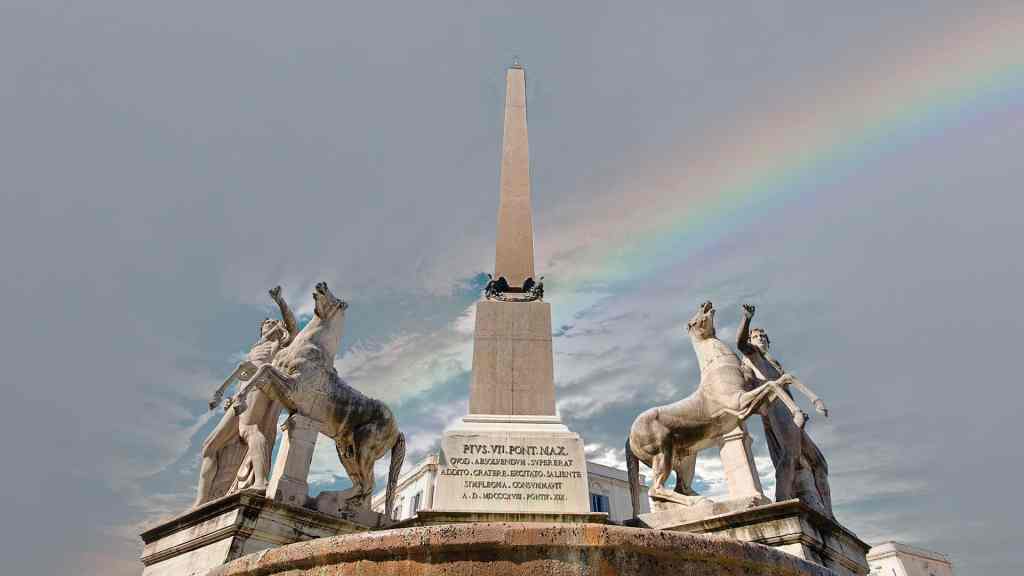
Similar to the Esquiline Obelisk and located on the square of the same name, it is made of granite, is about 14,63 meters high (28,94 mt with base and cross) and without inscriptions. It had the same fate of its twin since it was transported to Rome to decorate the Mausoleum of Augustus.
Discovered with the other for the first time around 1520 under Pope Leo X, unlike the twin that remained in the air for about 70 years along the public road before being placed in Piazza dell’Esquilino, this was soon reinterred . It was rediscovered around the middle of the 16th century by Monsignor Francesco Soderini, who became the owner of the area and authorized by the Pope to carry out excavations. But it was buried again and remained so for about 150 years; in the end the memory was lost.
The last and definitive time was found by chance in 1781 during the works for the foundations of nearby buildings. Shortly after the discovery, Pope Pius VI decided to re-erect it in 1786 among the sculptures of the Dioscuri (Roman copies of the II-III century AD from Greek originals of the 5th century BC by Phidia) on the Quirinale square, a decision that was not initially welcomed positively by the citizens.
The whole project of restoration and raising, which was entrusted to the architect Giovanni Antinori, took about 5 years. The base had to be completely redone, as the original had been destroyed. The work of arrangement also involved the rotation of the two compositions with the Dioscuri, which did not happen on the first attempt, as in the Antinori project, causing local witty mottos against the architect.
The last element added, in 1818, was the fountain by Raphael Stern Who replaced the One by Giacomo della Portamade up of the granite basin which, originally in Campo Vaccino, Giacomo della Porta had placed in the Roman Forum at the end of the 16th century.
Sallustian Obelisk at the Spanish Steps
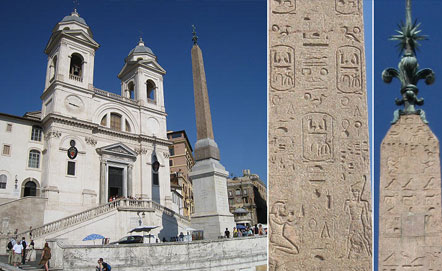
Located in front of the church of the Santissima Trinità dei Monti, right at the top of the famous Spanish Steps, the Sallustian Obelisk, unlike others brought to Rome without inscriptions and remained so, this was decorated with hieroglyphics after transport, such as those of Piazza Navona and the Pincio.
Dating back to the 2nd or 3rd century AD and carved in red granite, the obelisk is 13,91 meters high; with the base and cross it reaches 28,94 meters.
The decoration that covers it traced a copy of an ancient inscription on the obelisk in Piazza del Popolo. But the execution was quite imprecise, so much so that some signs would be carved upside down. The practice of copying was not new, since it was also quite widespread in Egypt.
The date of transport to Rome is not known, but it is certain that the obelisk was initially erected in the Horti Sallustiani, hence the name, between the Quirinale and the Pincio. On the death of the owners, the obelisk and the Horti (villa with gardens) were acquired by the Emperor Tiberius.
Fortunately it remained unscathed and standing during the devastation of 410 at the hands of Alaric and the Goths. In the end it fell but, despite the fact that for centuries it lay abandoned on the ground in three pieces in the modern Via Sicilia, it was never forgotten.
Pope Sixtus V wanted to erect it in front of the church of Santa Maria degli Angeli e dei Martiri, and for this reason he entrusted the restoration to Maderno, but the project was not followed up.
About a century later, Athanasius Kircker, who had discovered the secret of his inscription, proposed to Pope Alexander VII to erect it again, but it was only in 1734 that Pope Clement XII succeeded in having it transported to Piazza San Giovanni in Laterano, near the Scala Santa, where however it was not erected. On the contrary, for fifty years the three pieces remained abandoned on the ground. Indeed, in this period there were negotiations for its eventual transport to Paris where it would be erected in front of the Notre-Dame cathedral.
In the end, Pope Pius VI decided, albeit in a chorus of negative opinions and with some concern on the part of the Minimal Fathers of the Trinity who feared for the facade of their church, the erection at the top of the steps of Trinità dei Monti. The task was entrusted to the architect Giovanni Antinori.
The top of the Sallustian Obelisk was crowned with the heraldic symbols of the Pope and a cross that contained a fragment of the Holy Cross, the relics of St. Joseph, St. Francis of Paola, Pius V and the apostles Peter and Paul. The works were completed in 1787 and the inauguration took place on April 20th of the same year.
Obelisk of Antinous in Villa Borghese
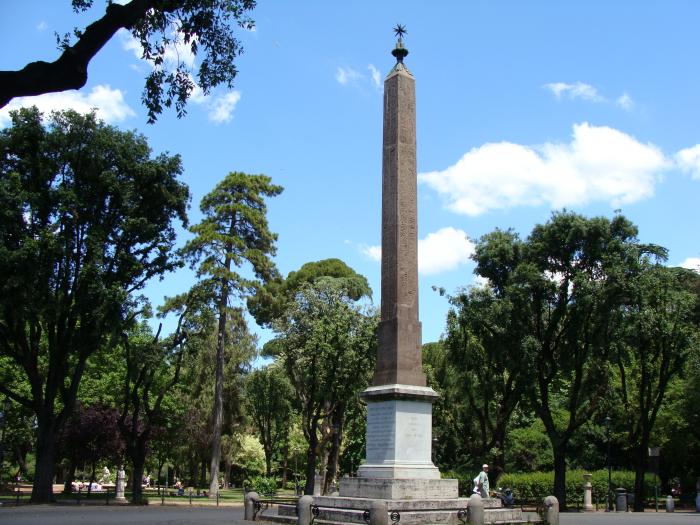
A few steps from the terrace of the Pincio, one of the most evocative viewpoints of Rome, the Aurelian or Antinous Obelisk stands, named after the young Greek loved by the emperor Hadrian, who was prematurely drowned in the Nile in unclear circumstances.
Hadrian deified Antinous and, in Egypt itself, temples dedicated to him and even a city called Antinopoli were erected. A temple was dedicated to him in Rome, and the obelisk was one of his ornaments. The hieroglyphs that cover it were carved to remember the life and tragic story of the young man.
A great lover of Egyptian art, of which he had collected notable examples in his villa in Tivoli, Hadrian ordered its transport to Rome.
In 300 AD the obelisk was transported to the Variano Circus, near the current basilica of Santa Croce in Gerusalemme to mark the spine and where it fell, breaking into three sections. In 1589 it was found here, and due to its proximity to the Aurelian Walls, it was called Aurelian.
Since that moment it passed through various properties and was transported to different places: among these we can mention a vineyard outside Porta Maggiore and the courtyard of Palazzo Barberini where it was moved in 1633, without however being raised.
In the second half of the 18th century it was acquired by the Vatican where it was erected by Pope Clement XIV in the courtyard of the Pigna.
Only in August 1822, by order of Pope Pius VII, as part of the work for the complete reorganization of the Pincian area and the public promenade conducted by Giuseppe Valadier, it reached its final location in Viale dell’Obelisco and was re-erected by architect Giuseppe Marini.
Carved out of pink granite, the Obelisk of Antinous is 9,24 meters high; with the base and the star on the top it reaches 17.26 meters.
Pantheon Obelisk (macuteo)
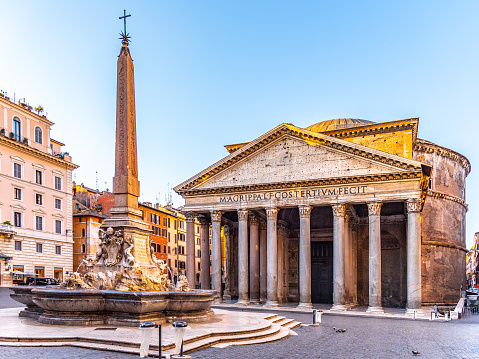
Together with the one visible today in Villa Celimontana, it was originally erected in Heliopolis by Ramses II. Together the two obelisks were brought to Rome to adorn the temple of Isis (Iseum).
It is made of red granite and is about 6,34 meters high. Its original height was perhaps 1-meter taller. The inscriptions report phrases that indicate the Pharaoh’s kinship relationship with the Sun god (“Excellent son of the Sun god”) and recall the works performed in honor of the god.
The details of the transport to Rome of the twin obelisks are not known. This, now facing the Pantheon, was discovered lying near the church of Santa Maria sopra Minerva, which had been erected on the ruins of the temple of Isis. Following its discovery, towards the end of the 14th century, it was moved in front of the small church of San Macuto and for this reason it is also known as Obelisco Macuteo o della Rotonda.
It was placed there in a very rudimentary way, on four dice that supported it and without any decoration. Rome in those years, following the abandonment of the popes who had moved to Avignon, was in great poverty and its population had dropped to about 25,000 inhabitants.
To give a more worthy arrangement to the small obelisk, various hypotheses were formulated at the time of Pope Clement XI (1700-1721): in the port of Ripetta, in Campo de’ Fiori, in Piazza SS. Apostoli, in front of the Palazzo di S. Marco or near the Arch of Constantine. In 1711 it was erected in its current location on a pedestal decorated with a fountain with dolphins, adapting it to the sixteenth-century fountain with the masks of Giacomo della Porta.
Mattei Obelisk in Villa Celimontana
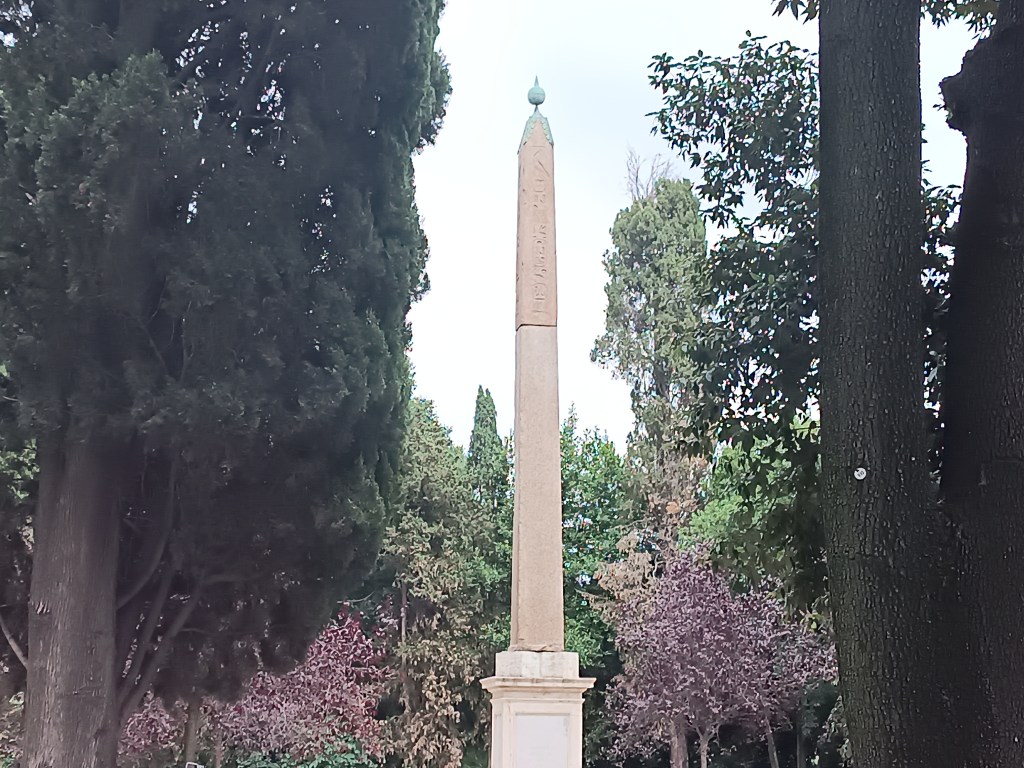
Erected by Ramses II in Heliopolis together with the obelisk in Piazza della Minerva, they were both shipped to Rome for the Temple of Isis located behind the Pantheon. In the 1300s it was moved to the surroundings of the Church of Ara Coeli but it probably fell later where it remained until the City Hall donated it to Ciriaco Mattei in 1582 who took it to his villa on the Celian Hill to be the first obelisk to be reerected in Modern Times.
Only the upper part (2,68 meters) is original and bears the name of Rames II whereas the lower part was added in Modern Times. It was also restored in the 1800s by the new owner of the Villa, Manuel de Godoy, prince from La Paz.
Obelisk in Piazza della Minerva
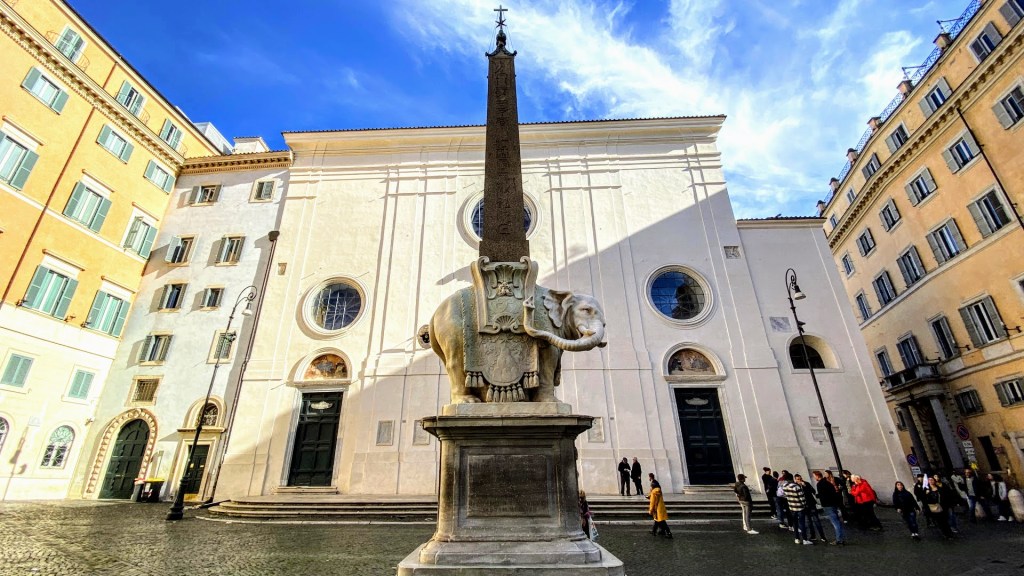
The Obelisk was made in Sais, close to Alexandria, and capital of Egypt during the 27th dinasty. It is made of red granite, 5,47 high and erected by the Paraoh Aprie (the one after Psammetin II) and brought to Rome with a twin obelisk which is nowdays in Urbino. Both obelisks were part of the temple dedicated to Isis and this one was discovered in 1655 accidentally by the dominican friars under Pope Alexander VII. It was studied by the german gesuit Athanasius Kircher who published an essay about it.
The project to rerect it was assigned to Gian Lorenzo Bernini who was inspired by the novel Hypnerotomachia Poliphili write by Francesco Colonna in which the character Polifilus meets an elephant bearing an obelisk. The elephant is traditionally a symbol of strenth, wisdom and religious compassion and the iscription in latin says that “it is the strongest of animals and it takes a strong brain to bear a solid wisdom”. The work was sculpted by Ercole Ferrata, Bernini’s pupil, but Pope Alexander VII unfortunately died three weeks before its inauguration in 1667.
Dogali Obelisk by Termini Station
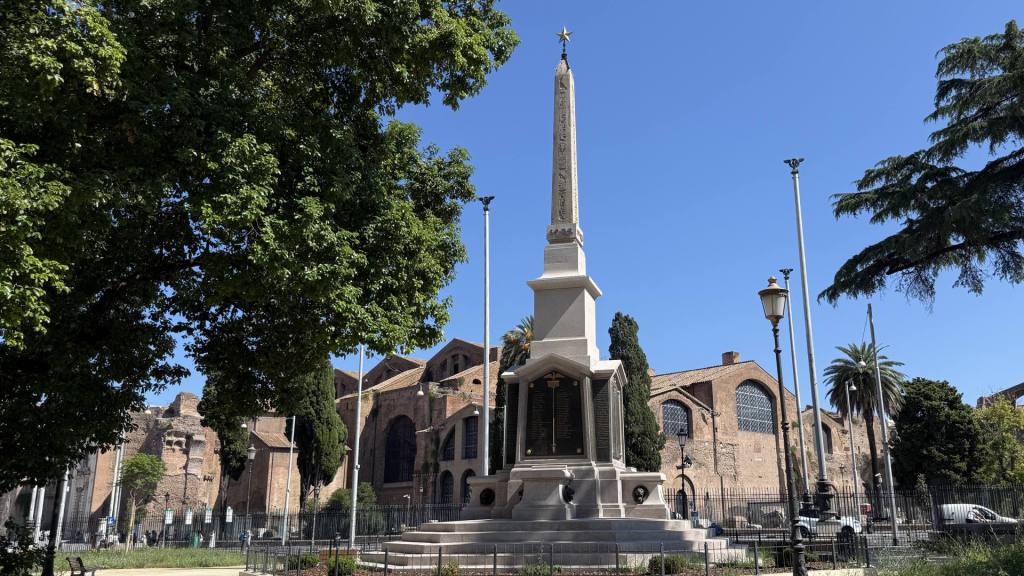
It is made of red granite and 9,25 meters high. It was erected in Heliopoli by Ramses II together with the obelisk now in the Boboli gardens. When it arrived in Rome, it went to decorate the Temple of Isis by the Pantheon and was discovered in 1883 close to the church of Santa Maria sopra Minerva. The monument was dedicated to the Dogali war in which 548 italian soldiers were trucidated in Eritrea.

